What the water line is and who owns which part
The water service line is the pipe that carries water from the main in the street, through a shutoff and the meter, to your house. Everything from the meter to the foundation, plus the piping inside, is normally the owner's responsibility, while the main and the equipment on the street side belong to the water district.
Wareham is served by two districts, the Wareham Fire District and the Onset Fire District, and outlying areas use private wells. Because the line crosses a property boundary, call your district before digging so you know where its responsibility stops.
When a failed water line is an emergency
A weak trickle can wait for a scheduled visit. These signs mean the line may be failing fast, so call the 24/7 line and then follow the list.
- Water is bubbling up in the yard or a driveway with no rain, or a strip of ground is soft, sinking or unusually green.
- Pressure drops to a trickle at every fixture, or the water stops completely and the district has not announced a shutoff.
- You hear water rushing near the meter or where the line enters the foundation, or the basement wall near the street side is wet.
- The meter runs with every fixture closed. This is the clearest sign of a leak between the meter and the house.
- Close the main shutoff inside the house. If it will not close, say so on the call so dispatch can plan for a valve replacement and a district contact.
Do not dig on your own, because underground gas, electric and communications lines can run close to a water service. The first excavation step is always the utility mark-out.
From the first call to a working line
A service line job runs in a clear order. Knowing it helps you plan around the work.
- 1
Confirm it is the service line
We run a meter test, then a pressure test from the meter to the house. If the leak is in the yard, acoustic listening usually puts the spot within a few feet. Leak detection covers these methods in detail.
- 2
Call Dig Safe
Massachusetts law requires a call to 811 before any excavation so marked underground utilities are located first. The plumber starts that call, and marking takes time, so an emergency repair may begin with a temporary solution.
- 3
Choose repair or replacement
A single pinhole or a failed fitting can be repaired. A line with several leaks, heavy corrosion or old galvanized steel is usually better replaced.
- 4
Dig or go trenchless
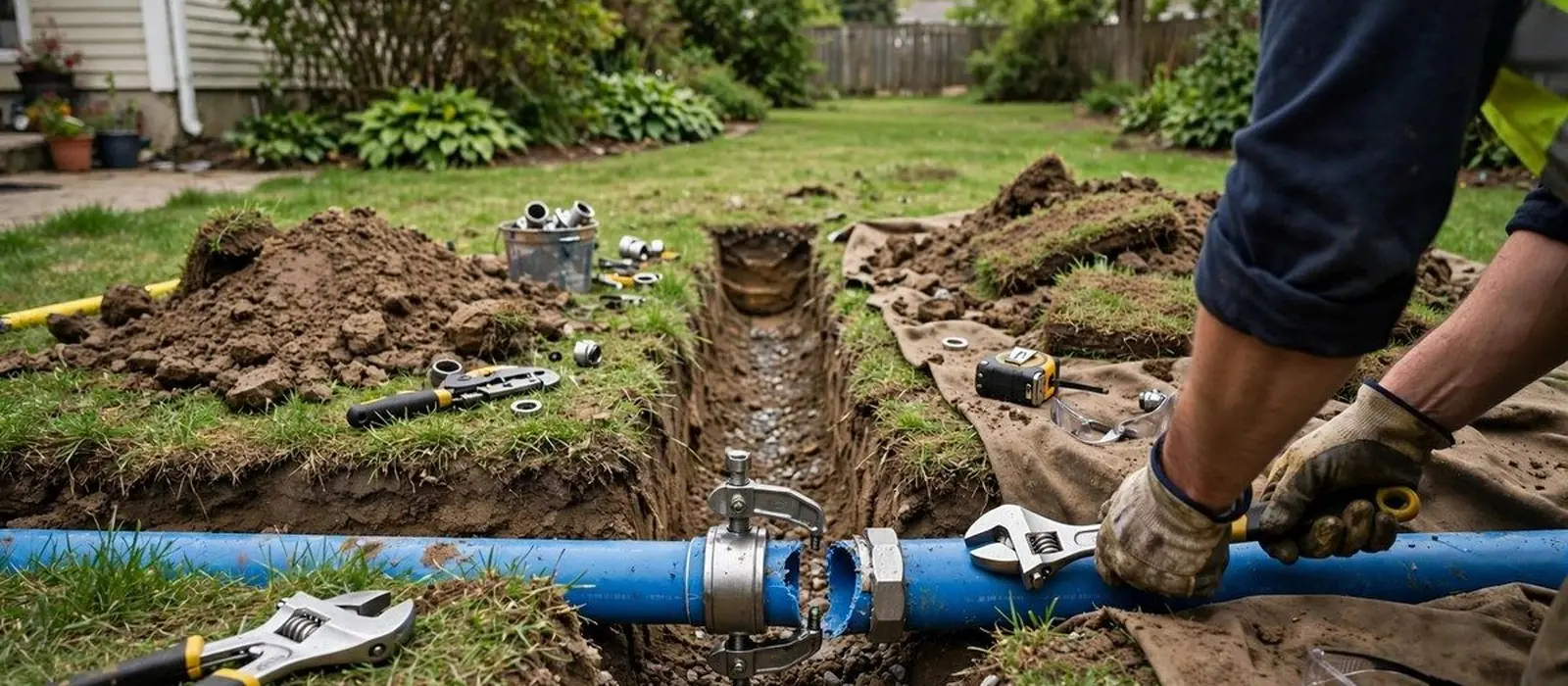
Open trenching exposes the line for a repair or full replacement. Trenchless methods such as pipe pulling can replace a line with smaller openings at each end, but only when soil and layout allow.
- 5
Test, backfill and restore water
The new pipe is pressure tested before the trench closes. Surface repair, such as lawn, paving or landscaping, is not our trade, and you will need a separate contractor for it.
Line leaking in the yard?
Call the 24/7 line and tell the dispatcher what you see and hear. A plumber is booked for the earliest open slot.
Pipe materials for the service line
Several materials are used for service lines, and the right one depends on your soil, your district's rules and how the house is plumbed. We explain the options on site.
| Material | Strengths | Watch for |
|---|---|---|
| Copper | Long track record, strong, widely used | Can corrode in aggressive soil or water, and joints in the ground need care |
| HDPE or PEX service pipe | Flexible, fewer joints, good for trenchless pulls | Fittings must be correct for the pipe, and some districts have their own specifications |
| Galvanized steel | Found in older homes, often 1939 and earlier | Rusts from inside, restricts flow and usually warrants replacement |
| Lead | Possible in the oldest service lines | Ask your district about its records and replacement programs |
Low pressure when the whole house is affected
Low pressure at every fixture usually points to the incoming side, not one tap. Possible causes include a partly closed main or meter valve, a corroded service line with a narrowed bore, a leak that bleeds off flow before it reaches the house, or a pressure reducing valve that has failed.
We start with a gauge on a hose bib to read static pressure, then compare it with pressure while water runs. If the gauge reads normal and a single fixture is weak, the issue is local, and faucet repair may be the right fix. If it is poor everywhere, we look at the line and valves.
Private wells are a different system
Homes in the outlying parts of Wareham and in neighboring towns often use a private well. The water line from the well to the house is a separate buried run, and it ends at a pressure tank and a pump, not a district meter. A line failure can look like a failing pump, because both cause low pressure and a pump that cycles constantly.
We check the pressure tank, the pressure switch and the buried line together. If the pump is running but pressure is low, a leak in the line or a waterlogged tank is as likely as a worn pump, and sorting that out first saves buying a part you do not need.
No water or a trickle at every tap?
Check the main valve is fully open, then call. If the line is the cause, the dispatcher can book a plumber and explain what happens next.
Repair or replace the service line
Neither choice is right for every property. We lay out the trade-offs after the pressure test and the dig plan.
Repair makes sense when
- The line is otherwise sound and the leak is a single point
- The pipe is a modern material in good condition
- Access is easy and the break is shallow
- You are selling soon and want a limited scope
Replace makes sense when
- There are repeated leaks along the same run
- The line is galvanized, lead or heavily corroded
- Pressure has been poor for years
- Excavation is already needed, since the trench is open anyway
What affects the price of water line repair
You hear a clear price before work starts. These factors drive it, and a call with your address and symptoms helps us give a range ahead of the visit.
Insurance policies vary on underground line damage. Some include service line coverage as an add-on, and many exclude wear and corrosion. Check with your insurer before work starts. Want your own number? Call (508) 389-4045.
Permits, inspection and nearby coverage
Replacing a water service line is plumbing work that needs a permit in Massachusetts under 248 CMR 3.05, and the permit is pulled by a licensed plumber. In Wareham, Inspectional Services at 54 Marion Road handles plumbing permits. A district may also require its own inspection of the work near the meter.
The same dispatch covers Rochester and Carver, where private wells are common, so we can pair a line repair with burst pipe repair inside the house when the damage reaches indoors.
Frequently asked questions
Yes. The line is answered 24/7, including nights, weekends and holidays. Tell the dispatcher where the water is showing and whether the main valve is closed, and the next open plumber is booked. Utility mark-outs follow their own schedule, so we plan around them.
Close every fixture and look at the meter. If it still moves, the leak is between the meter and a fixture. A pressure test from the meter to the house, plus listening in the yard, tells us whether it is the buried line or the piping inside.
In general that is the water district's responsibility, while the line from the meter to the house is the owner's. Rules differ by district, so call the Wareham Fire District or the Onset Fire District to confirm where its part ends.
Yes. Massachusetts requires a Dig Safe request before excavation so marked utilities can be located. Your plumber normally makes the call, and hand digging near marked lines is part of safe work.
Sometimes. Trenchless methods can replace a line with smaller openings at each end, but they depend on soil, pipe material and what else is buried nearby. We explain the options after a site look and tell you honestly when a trench is the only way.
It could be either. We check pressure at the tank, the switch settings and the buried line before blaming the pump. A leak or a waterlogged tank can mimic a bad pump, so testing first saves buying parts you do not need.
No. We repair the water line and backfill the trench. Loam, seed, paving and landscaping are other trades, and we can tell you what the site will need so you can schedule them.