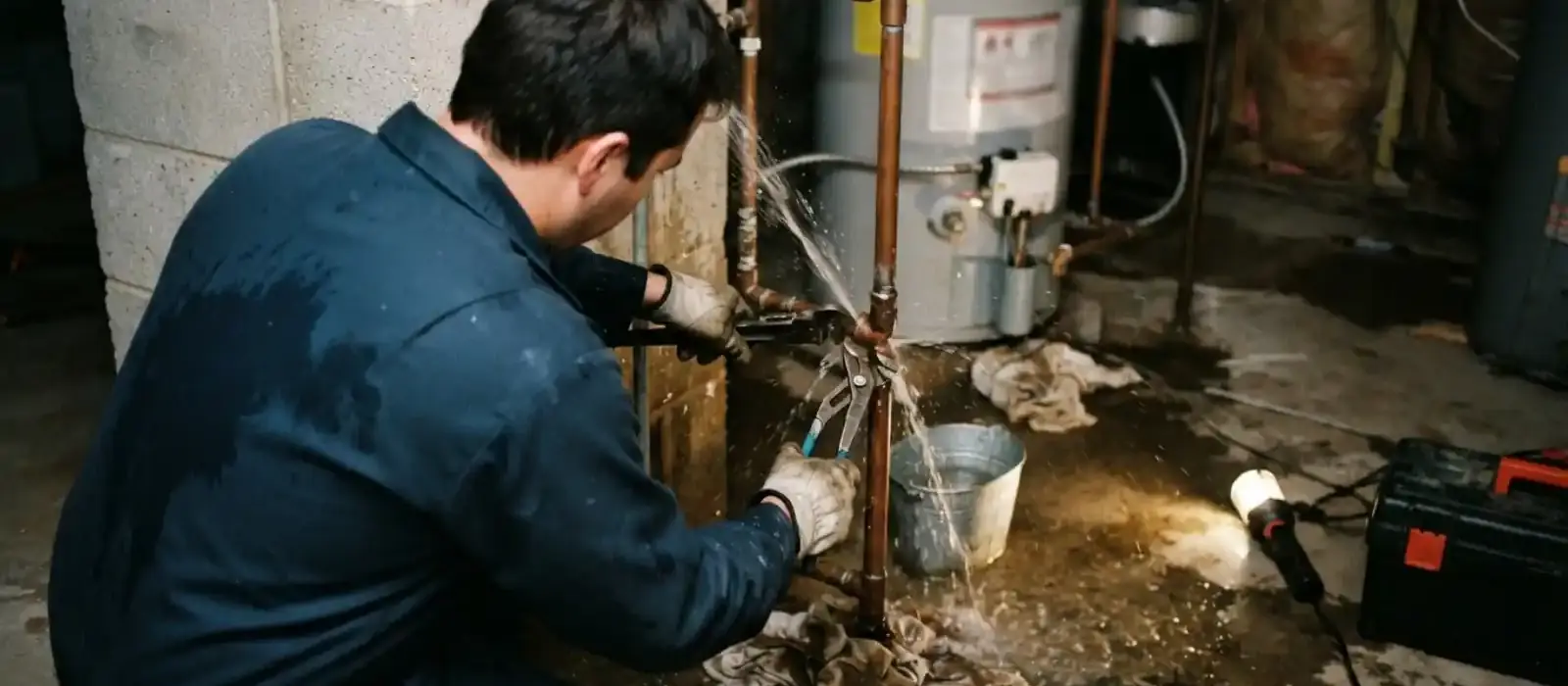
When a burst pipe is an emergency: shut it down first
Any pipe that is spraying, pouring or soaking a ceiling is an emergency. Do these in order, and keep your phone with you while you work.
- 1
Find the main shutoff
It is usually where the water line enters the house, often in a basement, a crawlspace, a utility closet or beside the water heater. The valve is either a round wheel or a lever. Turn a wheel clockwise until it stops, and turn a lever a quarter turn so it sits across the pipe.
- 2
Drain the lines
Open the lowest cold faucet in the house, then the highest one, and flush a toilet. This releases pressure and pulls standing water out of the broken section.
- 3
Cut power to wet areas
If water is near outlets, light fixtures, a panel or appliances, turn off the circuit at the panel, but only if you can reach it without stepping in water. If you cannot, stay out and tell the dispatcher.
- 4
Shut off the water heater
Turn the gas valve to off or the electric breaker to off. A tank with no incoming water can overheat or damage its elements.
- 5
Protect what you can
Move furniture and valuables, lay towels, and photograph every wet surface for your insurance claim. Then call the 24/7 line if you have not already.
What actually makes a pipe burst
Freezing is the textbook cause, since water expands as it turns to ice and the pressure builds between the ice plug and a closed faucet. The split usually forms in the pipe wall next to the ice, not at the ice, which is why a thawed line can seem fine and then pour water an hour later.
Corrosion is the other big cause. Old galvanized steel rusts from the inside and thins until a spot gives way, and copper can develop pinholes that grow into a spray. Water hammer from a fast-closing valve, a failed fitting and a pipe nicked during a past repair also account for many calls.
Seasonal homes and the first spring turn-on
Wareham's housing plan notes a large seasonal housing stock, and cottages that were not fully drained in the fall are the ones most likely to split a line over the winter. Because the water is off, nobody sees the damage until the main is opened in spring, and then the leak runs into a closed house.
If you are reopening a cottage, open the main slowly and check the meter and every wall and ceiling before you leave. A split pipe found on day one is a repair. The same split found two weeks later can mean wet insulation, mold and a floor that needs replacing.
Water pouring in right now?
Close the main valve, then call the 24/7 line. The dispatcher books the next open plumber for your address.
How we repair different pipe types
The right repair depends on the material and on where the split is. We explain the options and the trade-offs before cutting anything.
| Pipe type | How it fails | Common repair | Honest limit |
|---|---|---|---|
| Copper | Freeze split, pinholes, failed solder joint | Cut out the damaged section and sweat in new copper with couplings | Many pinholes in one run mean the pipe is wearing out everywhere |
| PEX | Freeze split or a failed crimp fitting | Cut out the bad section and join with crimp or expansion fittings | PEX tolerates freezing better, but fittings still fail |
| CPVC | Brittle cracks at fittings | Replace the cracked fitting and nearby pipe | Aged CPVC can crack again nearby |
| Galvanized steel | Rust-through, threaded joint failure | Short repair if possible, otherwise replace the run | A patch often just moves the next leak, so ask about repiping |
| Slab or buried line | Corrosion or ground movement | Locate, then repair or reroute | May need excavation, and we confirm with leak detection first |
How a burst pipe visit goes
Once the plumber arrives, the order of work is the same for most homes.
- Confirm the water is off and confirm the main valve works. A stuck or leaking valve gets replaced so you have a reliable shutoff.
- Open the damaged area just enough to see the split and the pipe on either side of it.
- Cut back to sound pipe, not to the edge of the visible damage, because weakened pipe next to a split often fails again.
- Make the repair, restore water slowly and look for air, hammer and new leaks at every joint.
- Test the line under pressure, tell you what was found, and leave you with notes on any other pipe that looks suspect.
If the pipe is wet inside a wall, the plumber stops at the pipe. Patching drywall, repainting and drying out the structure belong to a drywall or restoration contractor, and your insurer may have its own list.
Frozen but not yet burst
If a faucet is dripping nothing and a pipe is cold and frosty, you may have time. Open the faucet, wrap the pipe with towels soaked in warm water or aim a hair dryer on low at the frozen section, and work from the faucet back toward the frozen spot. Never use a torch or open flame, which has started house fires and can damage a joint.
If you see a bulge, a crack or water where there was none, stop thawing and close the main. Call right away, because a pipe that has already split is better repaired on your schedule than discovered at 3 a.m. The same crew can pair the repair with leak detection if you suspect a second break.
Found a wet ceiling or a hissing wall?
Even a slow spray can ruin a floor by morning. Call now and a dispatcher lines up a plumber for the earliest open slot.
What affects the price of burst pipe repair
You hear a clear price before work starts. These factors are what move it, and a description on the phone helps us give you a range ahead of the visit.
Homeowners policies often cover sudden burst pipe damage but may exclude a slow leak, and many ask you to protect the property from further loss. Keep photos, receipts and the plumber's notes. Want a real number? Call (508) 389-4045.
Permits and the repair itself
Most plumbing work needs a permit in Massachusetts under 248 CMR 3.05, and permits go only to licensed plumbers. The rules do allow a licensee to make an emergency repair first, as long as tests are done, the inspector is notified, and inspection happens no later than the next working day. Wareham's Inspectional Services at 54 Marion Road handles plumbing permits, and the plumber takes care of the paperwork.
If the burst traces back to a cracked line outside the house, water line repair is the service that applies. Dispatch also covers Bourne and Middleborough, so the nearest open plumber may not be in Wareham.
Frequently asked questions
Yes. The line is answered 24/7, including nights, weekends and holidays. Tell the dispatcher that water is flowing and whether the main valve is closed, and the next open plumber is booked for your address. Same-day appointments are offered when a slot is available.
It is on the pipe where water enters the house, usually in a basement, crawlspace or utility room. Homes on district water also have a meter nearby. If you cannot find the valve or it will not turn, tell the dispatcher, and your water district can tell you who handles the valve at the street.
Not necessarily. Ice can crack a pipe without any water showing until it thaws. After it thaws, check the pipe and walls, run each fixture, and watch the meter with everything closed. If it moves, call and we run a leak test.
Yes, if the burst is on a line feeding the tank. Switch off the breaker or turn the gas valve to off. Leaving it on with no water coming in can overheat the tank or burn out an electric element.
We repair the burst and look at the pipe around it. If the metal is thin, pitted or full of old patches, we explain the options, including replacing the run or a full repipe, and you decide. We do not push a big job when a small repair will hold.
No. We stop the water and repair the pipe. Drywall, insulation, flooring and paint belong to a restoration contractor or carpenter, and your insurer may also have a preferred drying and cleanup company.
Yes. Cottages are a common call, especially in spring when the water is first turned on. We repair the split, check the rest of the supply lines and can advise on draining and winter shutoff so it does not happen again.