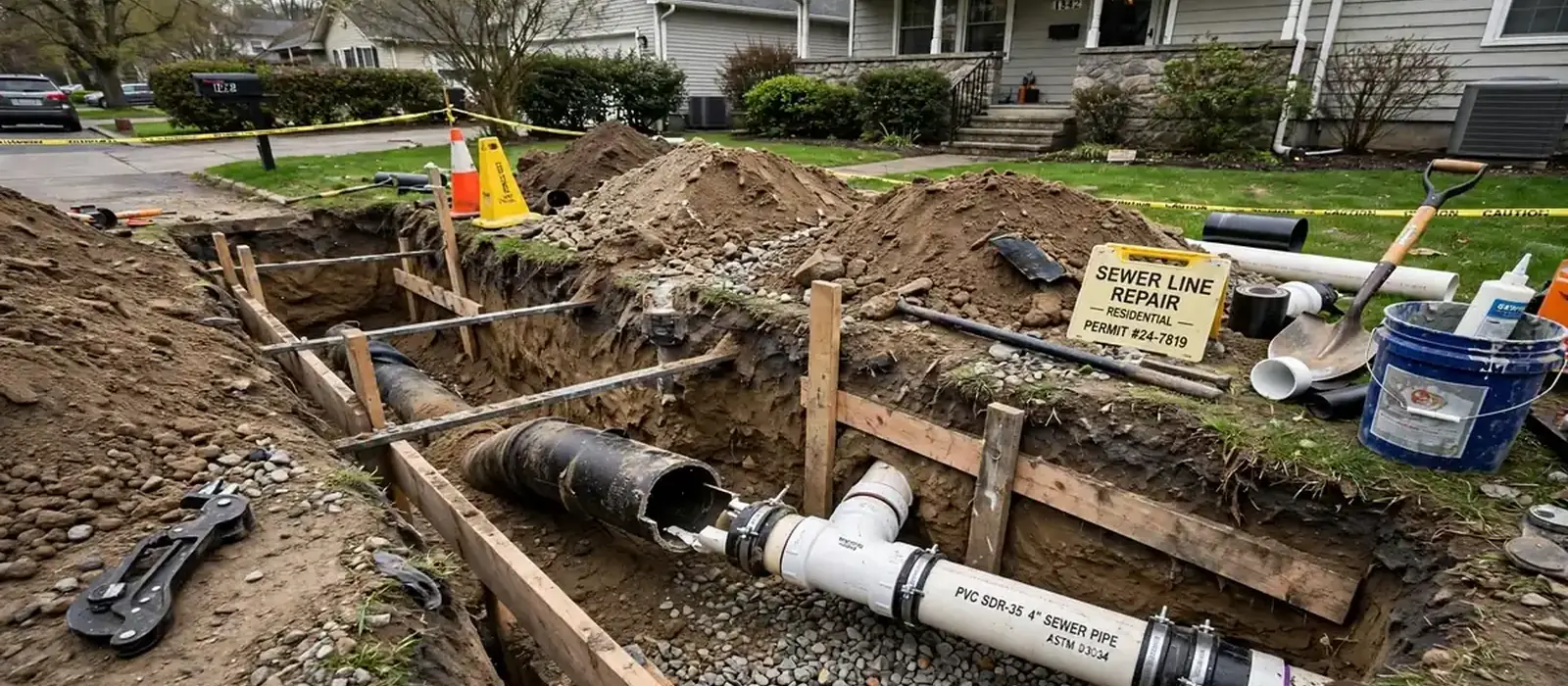
When a sewer line failure is an emergency
A sewer line problem is urgent when waste has nowhere to go. Use this list to decide, and call the 24/7 line if any item fits.
- Sewage or gray water is coming up through a basement floor drain, a tub or a shower, and it gets worse each time anyone flushes.
- Every fixture in the house drains slowly or gurgles, not just one sink. That points past the branch lines to the main run outside.
- A sinkhole, soft patch or very green wet strip has appeared in the yard along the path of the pipe.
- A sewage smell is strong in the basement or crawlspace, or you can see standing wastewater near the foundation.
- A drain cleaner has already been through and the line backed up again within days. A cable that clears a line only briefly often means the pipe is damaged.
Until we arrive, do not run the washer, dishwasher or showers. If sewage is touching a furnace, a water heater or an outlet, stay clear of it and shut off power at the panel only when the floor around the panel is dry.
What a sewer lateral is and why it fails
Your sewer lateral is the single pipe that carries everything from the house to the town main, or to a septic tank on private ground. It usually leaves the building through the foundation wall or slab, runs a few feet underground and ends at a connection you cannot see. Ordinary drain cleaning deals with the fixtures and branch lines inside the house. This page covers the buried part.
Wareham's own housing plan puts the median home at about 1969 construction, with roughly one house in five built before 1939. That mix means a lot of laterals are clay, cast iron or fiber pipe that has been in the ground for decades, with joints that open slightly over time.
How buried sewer pipe breaks down
The failure mode decides the repair. These are the four we see on camera most often.
Root intrusion
Fine roots find a loose joint, grow inside the pipe and form a mat that catches paper. Cutting the roots helps for a season, and the joint still has to be sealed.
Bellies and sags
Soil under the pipe settles, a low spot forms and waste sits there. A belly causes repeat clogs even when the pipe is not cracked.
Cracks and offsets
A joint pulls apart or a section shifts sideways. Groundwater and soil can then enter the pipe, and sewage can leak out.
Collapse
Old fiber or clay pipe can flatten or crush, which stops flow completely. A collapse usually means excavation or pipe bursting.
How we find the problem before anything is dug
We start with the camera, not the shovel. Pulling the wrong section of lawn is the most expensive mistake in this trade.
- 1
Locate a way in
We look for a cleanout, usually a capped pipe near the foundation or in the basement. If none exists we go in through a toilet flange or a roof vent.
- 2
Run the camera head
A waterproof camera on a push cable travels down the pipe and records the roots, cracks, bellies and breaks. You can watch the screen.
- 3
Trace and mark the depth
A locator picks up the camera transmitter from above ground, so we can mark the exact spot and depth of the problem on the surface.
- 4
Decide the repair
We explain what we saw and offer the options that fit it. The price is quoted before any digging or lining begins.
Sewage in the house right now?
Call the 24/7 line. A dispatcher books the next open licensed plumber for your address.
Dig and replace, or line the pipe
Both methods work when matched to the right pipe. The camera findings, not a sales preference, should pick between them.
Excavated spot repair or replacement
- Best for a short, clearly broken section such as one offset joint or a crushed run.
- Lets us fix a belly by re-grading the pipe bed so it drains properly.
- Disturbs lawn, walks or a driveway, and the surface has to be restored afterward.
- Uses new PVC pipe and fittings with sound joints.
Trenchless lining or pipe bursting
- Pipe lining pushes a resin-soaked liner through the old pipe and cures it into a new pipe inside the old one.
- Pipe bursting pulls new pipe through the old path while breaking the old pipe outward.
- Less digging, usually only an access pit at each end.
- Not suited to a pipe with a deep belly, a full collapse or severe offsets. We will tell you plainly if it will not work.
Match the symptom to the likely repair
Real jobs overlap, so treat this as a starting point. The camera inspection confirms which row you are in.
| What you see | Likely cause | Typical approach | Worth knowing |
|---|---|---|---|
| Repeat backups every few weeks | Roots at a joint or a belly | Clear, camera, then spot repair or lining | Cutting alone does not stop regrowth |
| One bad backup, then normal | Temporary blockage on a sound pipe | Sewer line cleaning | No repair needed if the camera shows clean pipe |
| Wet or sunken patch in the yard | Cracked or separated joint leaking | Locate, then excavate that section | Fix soon, as leaking waste can soften the soil |
| Cannot get a cable past one point | Collapse or heavy offset | Camera, then excavation or bursting | Stop forcing a cable into a broken pipe |
| Slow drains in a very old house | Cast iron scale or clay joint failure | Jetting first, replacement if thin | Camera shows remaining wall thickness |
Town sewer, septic tank or both
Wareham's Sewer Department runs about 61 miles of gravity pipe and 45 pump stations, and the town housing plan says the sewer could not be expanded north of Route 25. So one Wareham home may connect to a town main, while a neighbor a few miles away sends everything to a septic tank.
If your lateral runs to a town main, the question of who is responsible for which section is a question for the town, so ask the Sewer Department before assuming. If it runs to a septic tank, a failing pipe can also point to the tank inlet or a problem downstream. Title 5 inspections at a sale are done only by MassDEP-approved inspectors, and a plumber's camera findings can help explain a problem, but they do not replace that inspection.
What drives the price of a sewer line repair
Every sewer job is different, which is why we give you the number only after the camera has shown the pipe. These are the real drivers.
After-hours scheduling and weekends may change the schedule, but the clear price comes first. Ask your insurer too, because many homeowners policies treat sewer backup and buried line failure as optional coverage, and some exclude damage from long-term wear.
Not sure if it is the main line?
Describe what the drains are doing and the dispatcher will tell you whether to book a camera visit now or wait for morning.
When this is not a do-it-yourself job
Sewage carries bacteria, so entering a flooded basement, handling wet materials or digging in the yard around a broken line is a health risk. Rental drain machines also do real damage to a cracked pipe, because a cutting head can snag at an offset and make a small break into a large one.
Digging near a sewer lateral also risks hitting gas, electric or water lines that run close by. A locator and a licensed plumber with a permit handle that safely. Also see sewer camera inspection if you only want to know the pipe condition before you buy a house or plan a renovation.
Related work across the area
The same dispatch serves Carver, where homes use private septic systems, and Bourne, where parts of Buzzards Bay village are sewered. If roots or grease are the cause, hydro jetting often scours the line clean after a repair, so the problem does not rebuild.
Frequently asked questions
Yes. The line is answered 24/7, including nights, weekends and holidays. Tell the dispatcher that sewage is backing up, and the next open licensed plumber is booked for your address. Same-day appointments are offered when a slot is available.
If one sink is slow and the rest of the house is fine, it is likely a local clog. If multiple fixtures back up together, or a basement floor drain bubbles when you flush, the problem is in the main line. A camera confirms which.
Often, yes. Pipe lining and pipe bursting need only small access pits when the pipe is not collapsed or badly bellied. The camera decides, and we say plainly when digging is the only sound option.
Yes. We quote a clear price after the camera shows the pipe and before any digging or lining begins. If the scope changes because of what is under the ground, we stop and explain before going further.
Under 248 CMR 3.05, plumbing work that installs, replaces or repairs piping generally needs a permit pulled by a licensed plumber, while simply clearing a stoppage does not. Wareham's Inspectional Services office at Memorial Town Hall handles plumbing permits, so ask them about your specific job.
Yes. The pipe between the house and the tank can crack or root over just like a town lateral. Do not pump the tank to fix a backup before the pipe is checked, because the tank may be fine.
It varies by policy. Many treat sewer backup as an add-on and exclude damage from slow wear or roots. Ask your insurer, and keep photos and a copy of the camera findings.