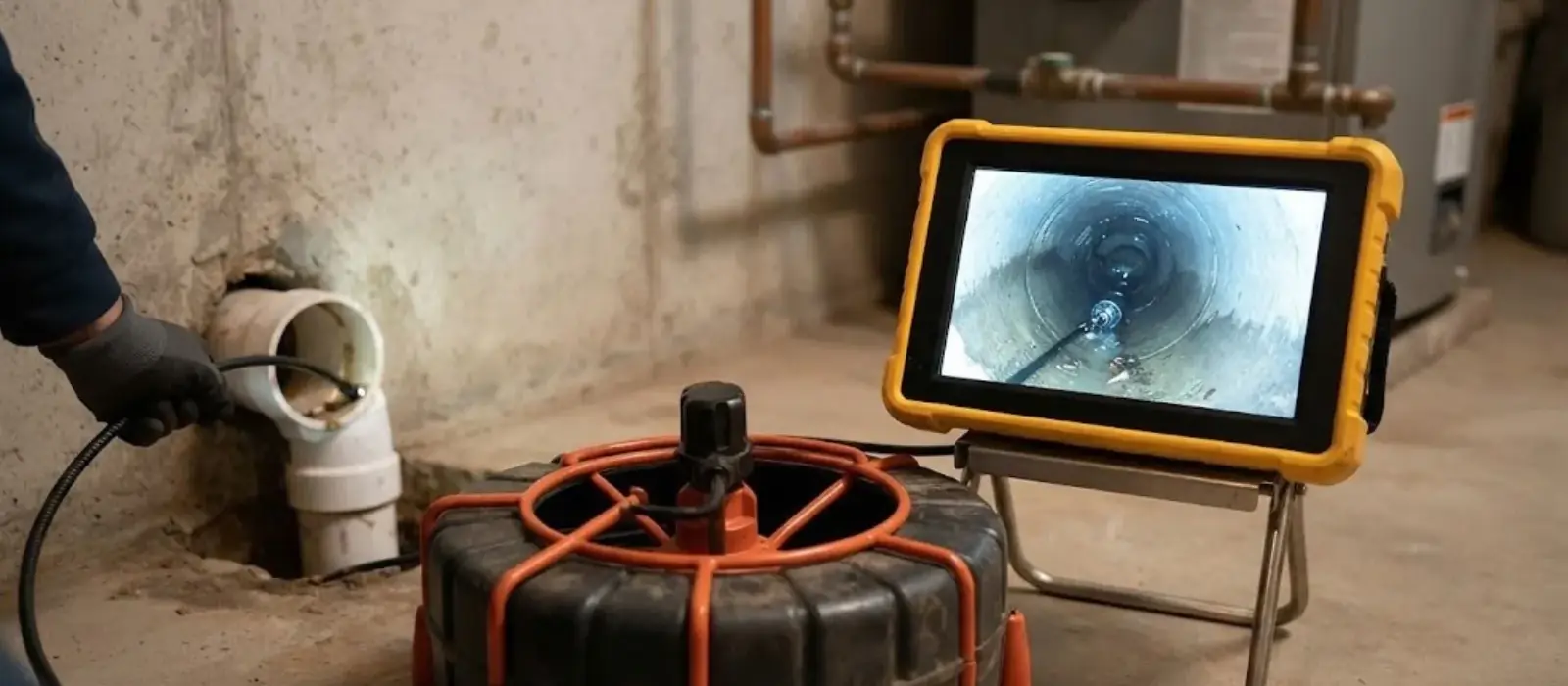
What a sewer camera inspection shows
The inspection uses a push cable with a color camera head and built-in lights, fed into the line through a cleanout. As the head moves, it records the pipe wall, the joints and any water pooling in low spots. A locator at the surface can pick up the camera transmitter, so a problem 40 feet in can be marked above ground.
You see the footage as it happens, and we explain the findings in plain terms. A pipe that looks clean needs nothing more. A pipe with roots or a crack gets an honest recommendation, which might be sewer line cleaning, a sewer line repair or simply a note to watch it.
How a visit works from start to finish
A routine inspection takes a short visit, and you do not need to be present for the whole thing.
- 1
Find the access point
We look for a cleanout near the foundation or in the basement. When none exists, the camera can go in through a toilet flange or a roof vent.
- 2
Clear what is in the way
If grease, paper or roots block the view, we may need to run a cable first. We tell you before doing so, because it changes the scope.
- 3
Record the run
The camera travels the full length it can reach, marking depth and distance on the video.
- 4
Review and decide
We walk through the footage with you and explain what, if anything, needs action. You decide what happens next.
When a planned camera inspection makes sense
This page is for planned work. If sewage is already backing up, call the 24/7 line and the dispatcher books the next open plumber. For everything else, these are the usual reasons to book.
- You are buying an older house and want to know the condition of the lateral before closing, not after.
- Drains in the home clog repeatedly even after cable cleaning, which suggests a damaged or sagging pipe.
- You plan a renovation, a new bathroom or an addition that will add load to the existing line.
- A large tree stands near the line, and you want to know if roots have entered a joint.
- You see damp or sunken areas on the lawn, or notice a faint sewage smell in the yard.
- A past repair was done, and you want proof that the new section is sound.
Want a look before you buy or build?
Call to book a camera visit. Same-day appointments are offered when a slot is open.
A plumber's camera is not a Title 5 inspection
Massachusetts requires a Title 5 inspection when a property with a septic system is sold. The rule is 310 CMR 15.300 to 15.305, the inspection is due within two years before or six months after the transfer, and only MassDEP-approved inspectors can perform it.
Our camera inspection is a different thing. It shows the condition of the pipe from the house toward the tank or main, and it can flag a cracked line, but it does not take the place of a Title 5 report and does not produce one. If you are selling or buying a septic property, you still need the approved inspector.
Buying a house in Wareham: why the pipe matters
Wareham's housing plan puts the median home at about 1969 construction, and roughly 20 percent of its housing predates 1939. A lateral from that era may be clay, cast iron or fiber pipe, and a standard home inspection will not usually put a camera in it.
The plan also calls out a large seasonal housing stock. A cottage that sat unused for months may show nothing wrong until the first full season of use. A camera visit before the purchase gives you a record of the pipe that you can use to negotiate a repair or plan a replacement.
What the footage can show and what comes next
The camera finds problems, and the repair depends on what is found. This table lists the common findings.
| What the camera shows | What it means | Common next step |
|---|---|---|
| Clean, smooth pipe | Pipe is in good order | None, keep records for future reference |
| Fine roots at a joint | Joint is loose and moisture is reaching roots | Cleaning or hydro jetting, then watch the joint |
| Standing water in a low run | A belly where waste collects | Repair or re-grade that section |
| Crack or open joint | Pipe has lost its seal | Spot repair or lining |
| Offset or collapse | Pipe has shifted or crushed | Excavation or pipe bursting |
| Scale or flaking inside cast iron | Pipe wall is thinning | Jet, then plan replacement as needed |
Sewer or septic in Wareham
Wareham's Sewer Department reports about 61 miles of gravity pipe and 45 pump stations, and the town housing plan notes that sewer expansion north of Route 25 could not be accommodated. In practice, a camera inspection on a house in the sewered part of town looks at your lateral up to the connection, while a house on septic is inspected toward the tank.
Source type: town Sewer Department page and Housing Production Plan
Closing date coming up?
Tell the dispatcher your timeline and the camera visit can be planned around it.
What affects the price of a sewer inspection
We give you the price before the camera goes in. A phone description of the house is usually enough for a clear number.
Scheduling around a closing date is common, so mention it when you call. We book planned camera visits around your calendar, and same-day appointments are offered when a slot is open.
Related work and nearby towns
If the camera shows only a clogged line, drain cleaning or sewer line cleaning may be all that you need. The same crews serve Marion, where roughly a third of developed properties are on septic, and Middleborough, where public sewer covers the center of town.
Where permits come into an inspection
A camera inspection is a look, not a repair, so it needs no permit. If the footage leads to replacing pipe, 248 CMR 3.05 requires a permit issued to a licensed individual before the work begins, and that is also the point where the town inspector gets involved.
Frequently asked questions
A typical visit on an accessible line takes a short part of the day. Blocked pipes, a long run or no cleanout take longer. We give a time window when you book.
No. Title 5 inspections for septic systems must be done by MassDEP-approved inspectors. A plumber's camera shows the condition of the pipe, which can help you decide on repairs, but it is not a Title 5 report.
If the house is older or has had repeat drain problems, yes. A standard home inspection usually does not include a camera in the buried line. The footage gives you something concrete to bring to a negotiation.
It helps a lot, but it is not required. If no cleanout exists, we can often get the camera in through a toilet flange or a roof vent. We also point out when installing a cleanout is worth doing.
Ask when you book. Mention that you need footage for a closing, an insurer or a contractor, and we will plan the visit to record it.
We explain what we saw and offer the repair options that fit it. The price is quoted first, and you decide whether to go ahead.
Yes. The camera follows the pipe toward the tank and shows cracks, roots and offsets. It does not inspect the tank or the leach field, which are part of the Title 5 process.