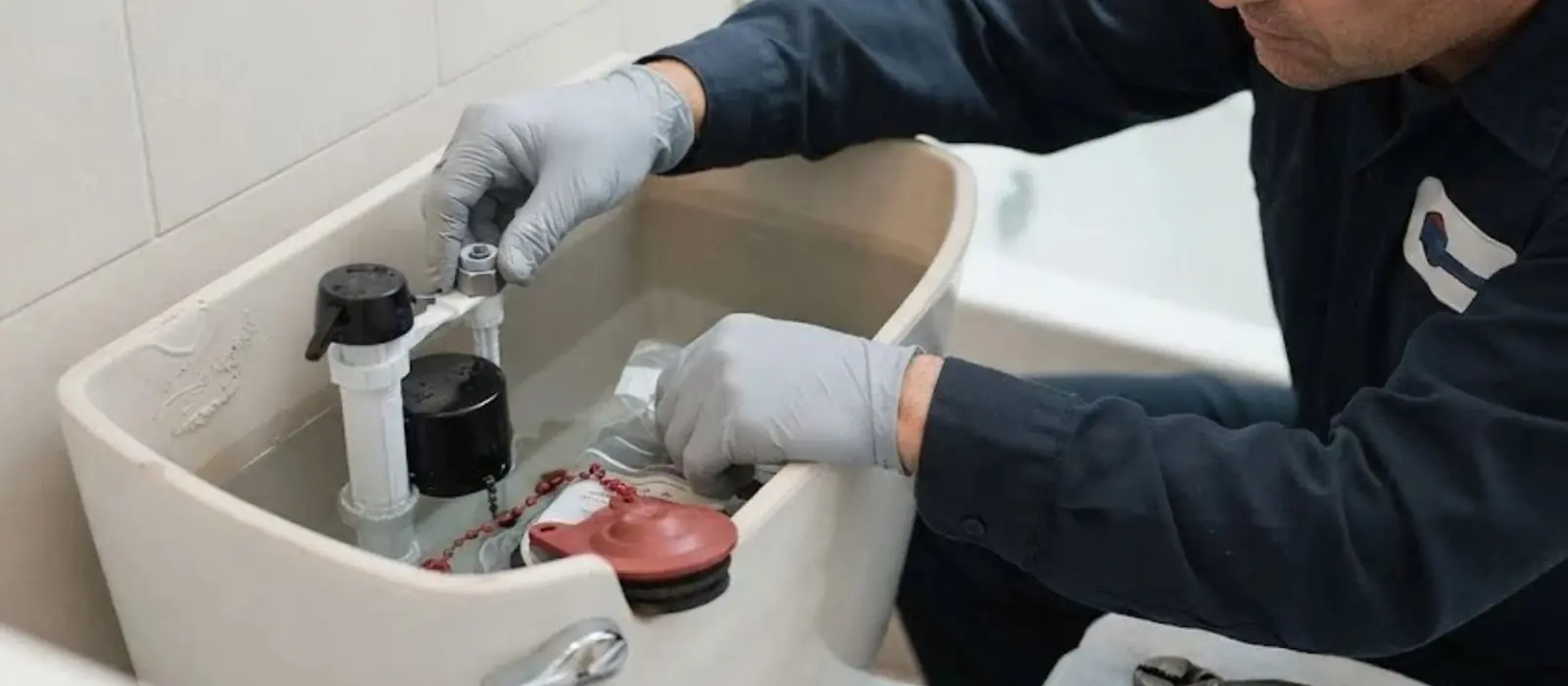
The five things that set the price
Plumbers look at the same short list every time. Knowing it helps you compare quotes honestly.
Hours also matter. A toilet that has failed overnight can be handled the same day when a slot is open, and the price is quoted before work begins.
Standard replacement versus a repair job
A clean replacement is straightforward. The old toilet comes off, the flange and floor look sound, the new bowl sets, and the supply line connects. The visit is short and the quote is simple.
The price moves when something under the old toilet is damaged. A toilet that has rocked for years may have cracked its flange or let water seep under the wax ring. Opening it up is the only way to know, and a plumber should say so before quoting rather than guess from the doorway.
How a toilet is installed, step by step
Knowing the order of operations helps you spot a rushed job. Each step has a reason.
- 1
Shut the water and empty the tank
Close the angle stop, flush, and sponge out the tank and bowl. Disconnect the supply line from the bottom of the tank.
- 2
Pull the old toilet
Remove the nuts on the closet bolts, rock the bowl free and lift it onto a drop cloth. Stuff a rag in the drain opening to hold back sewer gas.
- 3
Scrape and inspect the flange
Remove the old wax ring completely. Check that the flange is solid, sits flush on top of the finished floor, and has intact bolt slots.
- 4
Repair what is wrong
A flange repair ring, a replacement flange or a floor patch happens here, before anything new goes down.
- 5
Set the wax ring and the bowl
Place a new wax ring or a wax-free seal, new closet bolts in the slots, and lower the bowl straight down. Press, do not twist, so the seal compresses evenly.
- 6
Tighten, connect and test
Snug the nuts alternately, a little at a time, so the porcelain does not crack. Connect the new supply line, open the valve, and flush several times while watching the base and the tank.
Ready to swap a toilet?
Call the number below. A dispatcher books a licensed plumber and you hear the price before any work starts.
Wax ring or wax-free seal
Both work, and the choice depends on the flange and the floor.
Wax ring
- The standard seal, soft wax that molds to the flange and the bowl horn
- Works well when the flange sits on top of the finished floor
- A thick or extra-height ring can bridge a flange that sits slightly low
- Cannot be reused once the bowl is lifted
Wax-free seal
- A rubber or foam gasket that does not melt or flatten
- Useful where the bowl may be lifted again, such as a seasonal cottage
- More forgiving of small flange height errors
- Still needs a solid flange and a flat floor
Flange height is the detail that leaks
The flange should sit on top of the finished floor, not below it. When new tile or vinyl is laid over a flange that was set at the old floor level, the flange ends up recessed, and a standard wax ring cannot close the gap.
A recessed flange is fixed with a spacer ring or a thicker seal, but a flange sitting an inch down needs real work. Ask the plumber to measure it before choosing the seal.
Permits and licensing in Wareham
Plumbing work in Massachusetts is covered by 248 CMR 3.05, which requires a permit before plumbing is installed, altered, removed or replaced, and permits go only to properly licensed individuals. Leak repairs on a working part of a fixture and clearing a stoppage are exempt. Whether a like-for-like toilet swap needs one is a local question, so ask the Wareham Inspectional Services Department at Memorial Town Hall, 54 Marion Road, which also runs an online permitting portal.
You can check a plumber's license on the state's lookup under Plumbers and Gas Fitters before you hire. A licensed plumber is the one who can pull a permit on your behalf.
Source type: mass.gov 248 CMR 3.05 and Town of Wareham Inspectional Services
Common toilet types and what they mean for the job
The fixture sets the starting point for scope. Most Wareham homes fall in the first two rows.
| Toilet type | Installation notes | Cost pressure |
|---|---|---|
| Two-piece | Bowl and tank set separately, easy to carry | Lowest labor, standard bolts |
| One-piece | Heavy and awkward, needs two people | A little more time and care |
| Wall-hung | Tank hidden in the wall with a carrier frame | Wall work, rough-in changes |
| Dual-flush | Two buttons, adjustable fill valve | Same as two-piece |
| Pressure-assisted | Sealed tank, louder flush | Check supply pressure and line size |
Old houses and cottages
Wareham's housing plan puts the median home at about 1969 construction, and about one in five homes dates from before 1939. Older bathrooms often have cast iron drain stubs, patched subfloors and flanges set to a floor that has since been re-covered.
That is why a price given without seeing the bathroom can be off. Salt air near Onset and the bay shore can also corrode brass closet bolts and old shutoff valves, so expect those to be replaced as a matter of course. For related work, plumbing installation covers new fixtures and rough-in, and toilet repair applies when the toilet itself is still fine and only runs, leaks or flushes weakly.
Doing it yourself, honestly
A confident homeowner can set a two-piece toilet. The risks are a cracked bowl from over-tightening, a seal that leaks into the subfloor weeks later, and a flange problem you cannot see. A leak under the bowl is invisible until the floor softens.
A plumber also checks that the drain is clear, that the vent works and that the supply valve closes. If any of that is off, the new toilet inherits the problem. The same crews also work in Carver and Rochester, where private wells and septic systems add their own checks.
Want a clear price for your bathroom?
Tell the dispatcher the toilet type and what you see around the base. Same-day appointments are offered when a slot is open.
Frequently asked questions
Two bathrooms rarely match. A sound flange and a firm floor make a short job, while a rotted subfloor or a recessed flange adds repair work first. The price is given clearly before work starts, once the plumber has seen the base.
It is the ring on the floor that the toilet bolts to and that the wax ring seals against. If it is cracked, loose or too low, the new toilet will rock or leak no matter how good the bowl is.
Yes. Measure from the wall behind the toilet to the center of the closet bolts. Many are 12 inches, but older houses vary, and a mismatch means the tank will not sit properly against the wall.
No. Once the bowl has been lifted, the wax is compressed and will not reseal. A new wax ring or a wax-free seal goes in every time.
Yes, plan for freeze protection. Whoever closes the house for winter should drain the tank and bowl and put a non-toxic antifreeze in the trap. A wax-free seal can be handy where the toilet may be lifted for winter storage.