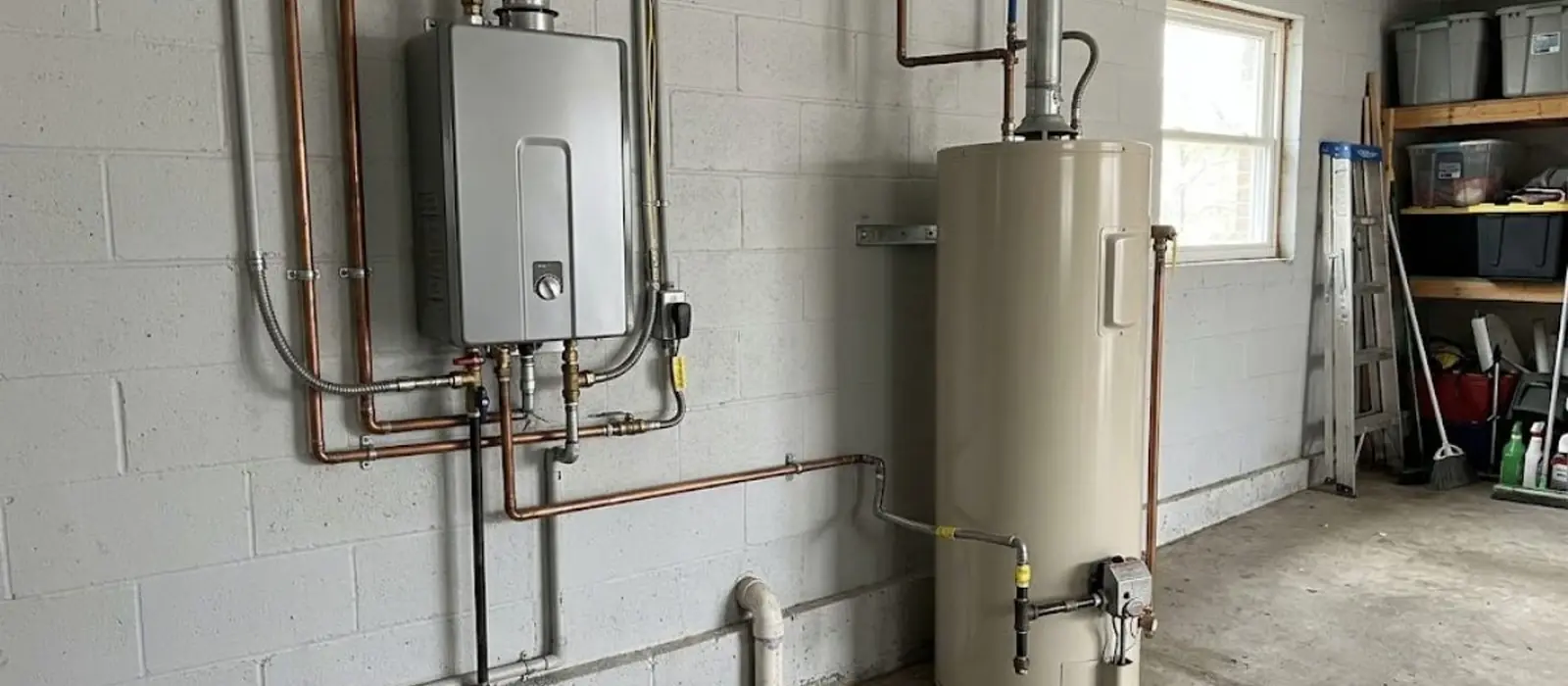
Non-condensing versus condensing, side by side
The difference is what happens to the exhaust, and nearly everything else follows from that.
Non-condensing
- One heat exchanger, exhaust leaves hot
- Vents through stainless steel, usually a double-wall or single-wall stainless system
- No condensate to drain
- Lower efficiency rating and lower unit cost
Condensing
- A second heat exchanger captures more heat from the exhaust
- Exhaust is cool enough to vent in PVC, CPVC or polypropylene
- Needs a condensate drain and often a neutralizer, since the liquid is acidic
- Higher efficiency rating and a higher unit cost
What the efficiency trade-off means in plain words
Efficiency ratings for tankless units are published by the manufacturer as a UEF number, and condensing models rate higher because they recover heat that a non-condensing unit sends outdoors. Look at the label for the actual figure on the model you are quoted, since it changes by brand and size.
In practice, a household that runs a lot of hot water every day gets more back from a condensing unit over time. A household with lighter use, or one that is swapping out an old stainless vent that still works, may find a non-condensing unit the sensible fit. Neither type is right for everybody.
Thinking about going tankless?
Call and a dispatcher books a licensed plumber to look at your venting and gas line. The price is clear before work starts.
What a non-condensing install needs
Four things have to line up before the unit goes on the wall.
Condensing models share the gas and water needs but swap the stainless vent for plastic and add the drain, so the vent route and drain location drive the choice.
Which fits which house
These are tendencies. A plumber looks at the actual venting path.
| Your situation | Leaning | Why |
|---|---|---|
| Existing stainless flue in good shape | Non-condensing | Reuse or match the existing vent path |
| Long exterior wall run available | Condensing | PVC vents easily out a side wall |
| No floor drain near the unit | Non-condensing | No condensate line to route |
| High daily hot water use | Condensing | Efficiency gain pays back through use |
| Replacing a tank with a tight budget | Non-condensing | Lower unit price, simpler install |
How a plumber sizes the gas line and vent
Skipping this part is how a new unit ends up underperforming.
- 1
Read the input rating
The unit's nameplate lists the maximum gas input in BTU per hour. That number sets the required flow.
- 2
Measure the run
The length of pipe from the meter or tank to the unit, plus the elbows and tees, changes how much gas gets through.
- 3
Compare against the sizing table
The plumber uses the gas piping tables adopted in the Massachusetts Fuel Gas and Plumbing Code, 248 CMR 10.00, for the fuel and pipe material in use.
- 4
Check the meter or regulator
A meter that fed a tank water heater and a furnace may not carry the added load. The gas company has to confirm that.
- 5
Plan the vent route
The termination must clear windows, doors and meter areas by the distances the manufacturer lists.
- 6
Permit and test
The licensed plumber pulls the permit under 248 CMR 3.05, tests the gas connection for leaks and has the inspector sign off.
Descaling is not optional on tankless
A tankless unit pushes water through narrow passages in the heat exchanger, and scale builds there over time. That shows up as longer waits, temperature swings and error codes. It is not a defect. It is how mineral-rich water behaves when heated fast.
Flushing is done by closing the isolation valves, connecting a small pump and hoses, and circulating a descaling solution through the unit, then rinsing. Intervals depend on your water and the manufacturer's manual. A unit that skips descaling for years can lose output or fail early, and a warranty may require the maintenance.
Wareham water and what it means for a tankless unit
The Wareham Fire District supplies water from seven gravel-packed wells in the Plymouth-Carver sole source aquifer and adds lime for corrosion control and pH. The Onset Fire District uses four groundwater wells and adjusts pH with sodium hydroxide. Both districts publish annual water quality reports, and neither page used for this guide lists a mineral level.
So read your own district's report and judge by what your fixtures show. Scale on the aerator or a kettle suggests the heat exchanger will see it too, and a descaling schedule should be set from there.
Source type: Wareham Fire District water page and Onset Fire District source water report
Flow rate and winter water temperature
A tankless unit is rated by how many gallons per minute it can heat by a given temperature rise. Cold incoming water in a Massachusetts winter is much colder than in August, so a unit that keeps up in summer may fall short when the shower, dishwasher and washer all run in January.
A plumber adds up the fixtures that run at the same time, picks a unit with margin for the coldest months, and explains what happens at the limit. When demand exceeds the rating, the water simply turns lukewarm rather than the unit failing. Two smaller units, or a tank for the busiest bathroom, are sometimes the better layout for a big household.
Should you stay with a tank?
A tankless unit saves floor space and gives a steady supply of hot water, but it does cost more to install, and it needs yearly attention. If your gas line is undersized or the vent route is awkward, a tank or a water heater installation with a power vent may be the cleaner answer.
If you have decided on tankless, tankless water heater service covers installing, repairing and flushing units. The same dispatch works in Bourne and Marion, so the answer does not change with the town.
Ready for hot water without the tank?
Describe your setup and we book a licensed plumber. Same-day appointments are offered when a slot is open.
What to do before you choose a non-condensing unit
Safety and venting come first with any gas appliance, so check these before you shop.
- Find out what kind of vent the unit needs and where it can safely exit the house.
- Make sure carbon monoxide alarms near the bedrooms and the utility area work.
- Never run a gas appliance with a blocked, loose or damaged vent.
- If you smell gas, leave the house and call the gas utility or 911 before you call a plumber.
Frequently asked questions
It means the unit does not capture heat from its exhaust to the point where the gas turns to liquid. The exhaust leaves hot and goes out through stainless steel venting. No condensate drain is needed.
No. Hot exhaust can soften or melt plastic pipe. Use the stainless vent material listed by the unit's manufacturer.
Not always. It rates more efficient, but it needs a drain and a plastic vent run, and it costs more up front. A non-condensing unit can be a good fit where a stainless flue exists or no drain is nearby.
Often not without a check. Tankless units draw much more gas at once than a tank. The plumber measures the run and sizes the pipe, and the gas company confirms the meter can carry the load.
Follow the manufacturer's manual and adjust for what your district's water report and your fixtures show. If you see scale on faucet aerators or in a kettle, descale more often. A plumber can set the interval after looking at the unit.