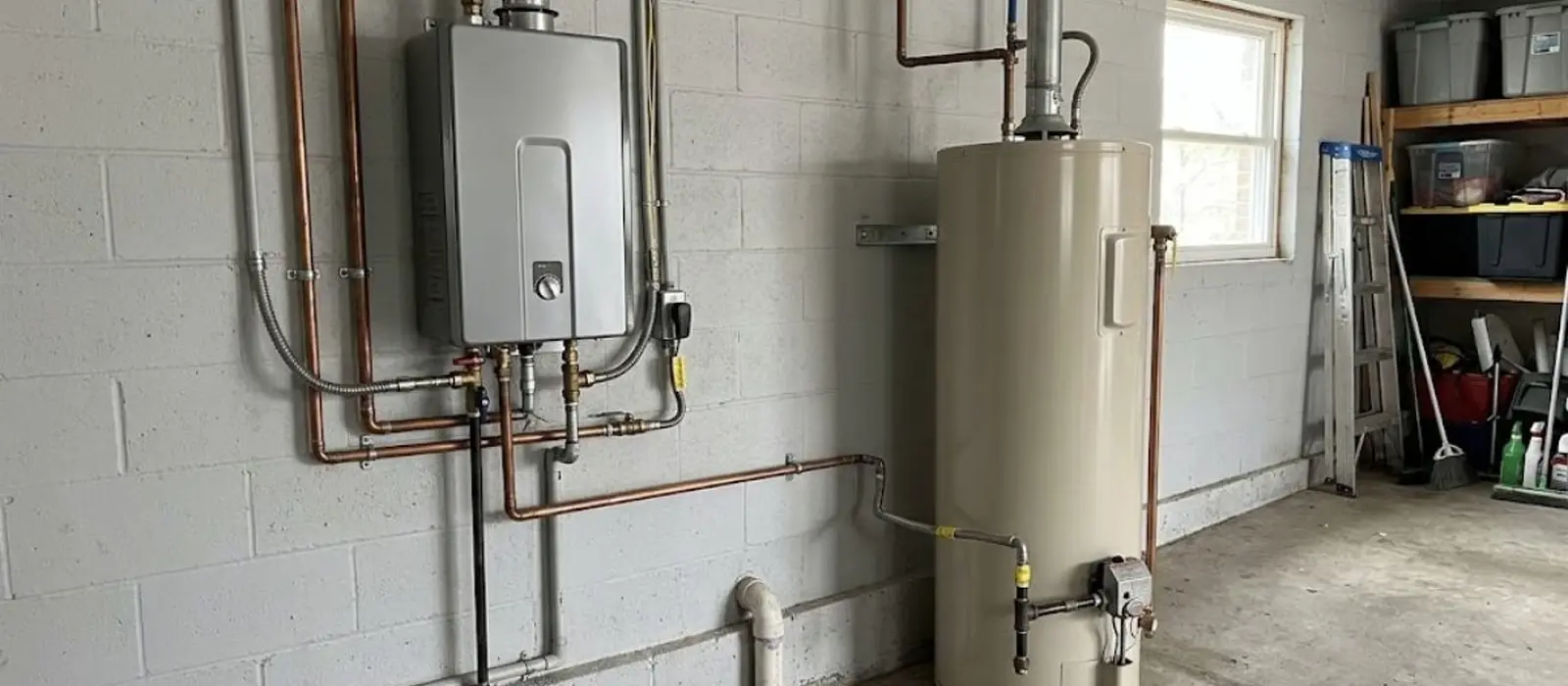
Signs your tankless heater is due for service
Owners often tell us the unit is running but something has changed. These are the changes that usually point to service, not a failure.
Hot water takes longer or runs cooler
Scale on the heat exchanger slows heat transfer. A descale usually brings back the original temperature.
Error code on the display
The code points to a flame, flow, ignition or vent problem. Look up the model's code list, then call if it returns after a restart.
Water temperature swings
Inlet screens clogged with sediment or a flow rate below the unit's minimum can both cause it.
Unit cycles on and off
Low flow through a fixture, or a sensor reading that is off, often explains short cycling.
Louder rumble or kettle noise
Scale or a failing fan. A flush quiets scale, while a fan needs a part.
Flushing and descaling, step by step
A tankless unit has a narrow heat exchanger, so mineral scale builds up faster than it does in a big tank. Descaling circulates a food-grade acid solution, usually white vinegar or the maker's product, through the unit with a small pump and hoses connected to the service valves.
Most manufacturers describe a flush as an annual task. After the circulation, the inlet filter screen is cleaned, the unit is rinsed with clean water and the temperature and flow are tested. Service valves are what make this possible, and units installed without them cost more to service.
Tank or tankless
The right choice depends on the household and the house. This table lays out where each type fits.
| Point | Tank heater | Tankless heater |
|---|---|---|
| Hot water supply | Limited by tank size, then recovers | Continuous, limited by flow rate |
| Floor space | Needs a footprint | Wall mounted, small |
| Gas or electric needs | Standard | Larger gas line or heavy electric service |
| Venting | Draft or power vent | Stainless, polypropylene or PVC, depending on the model |
| Maintenance | Anode and sediment flush | Descale, inlet screen and condensate drain |
| Best fit | Smaller budgets, simple swaps | Households with high demand and room to run a new line |
Tankless unit acting up?
Call and tell us the brand and the code on the display. We book a licensed plumber with the right service tools.
Water quality and why it affects tankless units
Wareham's water comes from two districts. The Wareham Fire District pumps from wells in the Plymouth-Carver aquifer and adds lime to protect pipes, while the Onset Fire District treats its well water with sodium hydroxide for the same purpose. Neither district's pages that we reviewed give a mineral figure, so ask each district for its latest water quality report if you want to see what your unit is handling.
Homes in nearby Middleborough and Carver may be on a different supply again. The takeaway for owners is practical, since the minerals in your water decide how quickly scale forms, and scale is what a descale removes.
Thinking of going tankless?
Tell us the fuel, the number of baths and the room. We explain what the house needs and a clear price, then book a licensed plumber.
What a tankless installation involves
Putting a tankless unit in is a bigger scope than swapping a tank. These are the steps in order.
- 1
Load check
The plumber adds up the gas or electrical demand of the new unit and compares it with your supply.
- 2
Gas line or circuit
A gas unit often needs a larger pipe and a regulator check. An electric unit may need a heavy new circuit and panel capacity.
- 3
Venting
A sealed, condensing unit vents with plastic pipe through a wall. A non-condensing one needs stainless venting.
- 4
Condensate and pressure
Condensing units need a drain for acidic condensate. Pressure and flow are checked against the unit's range.
- 5
Install, test, program
The unit is mounted with service valves, a relief valve and a tested connection, then set to the temperature you choose.
- 6
Permit
A licensed plumber pulls the plumbing and, for gas, the gas permit, as 248 CMR 3.05 requires.
Condensing and non-condensing tankless
The label tells you how the unit gets rid of exhaust, and that decides the vent material and the drain.
Non-condensing
- Exhaust is hot, so it needs stainless steel venting
- No condensate drain
- Lower initial cost, lower efficiency
- Fits an existing flue path more easily
Condensing
- Captures extra heat so exhaust is cooler, and vents in plastic
- Needs a drain for condensate
- Higher efficiency
- Better where a new sidewall vent is simple
When a tankless unit is not the right choice
Some homes should keep a tank. A small gas line that would need a long upgrade, a panel with no spare capacity, or a cottage used a few weekends a year all push the answer toward a conventional tank installation.
We would rather say that on the phone than sell a unit that will disappoint. A short description of the house, the current heater and how many baths run at once is enough for an honest recommendation.
Questions to answer before buying
These points keep the project from stalling after the unit arrives.
- What fuel is available at the heater location, and what is the pipe size?
- How many fixtures will run at the same time at peak, and what is their combined flow?
- Where would the vent run, and is there a wall that can take a termination?
- Is there a floor drain or other route for condensate?
- Will the house freeze when empty? A seasonal cottage needs a winter drain-down plan.
- Do you want recirculation, which reduces wait time but adds a pump and parts?
Freeze risk is real for a tankless unit left in an unheated space with water inside it, so a cottage owner should plan a shutdown routine from day one.
What affects the price
A clear price comes before work starts. These are the reasons one tankless job differs from another.
If the old unit has failed
Not every tankless problem needs a new unit. If it will not light or throws the same code again and again, water heater repair diagnosis comes first, and the answer is often a sensor, a fan or a flush rather than a replacement.
What to do before a tankless install visit
A few steps reduce damage and risk, and they apply whether or not a plumber is on the way.
- Find your gas meter and note the size of the existing gas line, since tankless units draw much more than a tank.
- Check where an exhaust vent could safely run to the outside, and keep that wall and roofline clear.
- Never run a gas appliance with a blocked or damaged vent, and make sure carbon monoxide alarms work.
- If you ever smell gas, leave the house and call the gas utility or 911 before calling a plumber.
Frequently asked questions
Most manufacturers call for a flush about once a year, and more often where the water is mineral-heavy. A unit that has gone years without one may need a longer descale.
Yes. We service and flush tankless water heaters regardless of who installed them. Tell the dispatcher the brand and any error code, and the right tools come along.
It sends hot exhaust through stainless steel venting and has no condensate drain. A condensing unit pulls more heat from the exhaust, so it vents in plastic and needs a drain.
Yes. Installing or replacing a water heater needs a plumbing permit pulled by a licensed plumber under 248 CMR 3.05, and a gas unit also needs a gas permit. Wareham Inspectional Services handles the rules.
Most gas units need electricity for the fan, igniter and controls, so they stop in an outage. Ask about a battery backup or a generator plan if outages are a concern.
Sometimes, but many tankless units draw more gas than a tank, so the existing pipe needs to be checked. The plumber measures the run and adds up the connected load first.
That is the cold water sandwich. Hot water still in the pipe cools, the unit fires again and a pocket of cold passes through. A recirculation loop or a small buffer tank reduces it.
Often not. A heater that sits for months needs a careful drain-down every fall, and a conventional tank may be simpler. We talk through the season of use before recommending either.