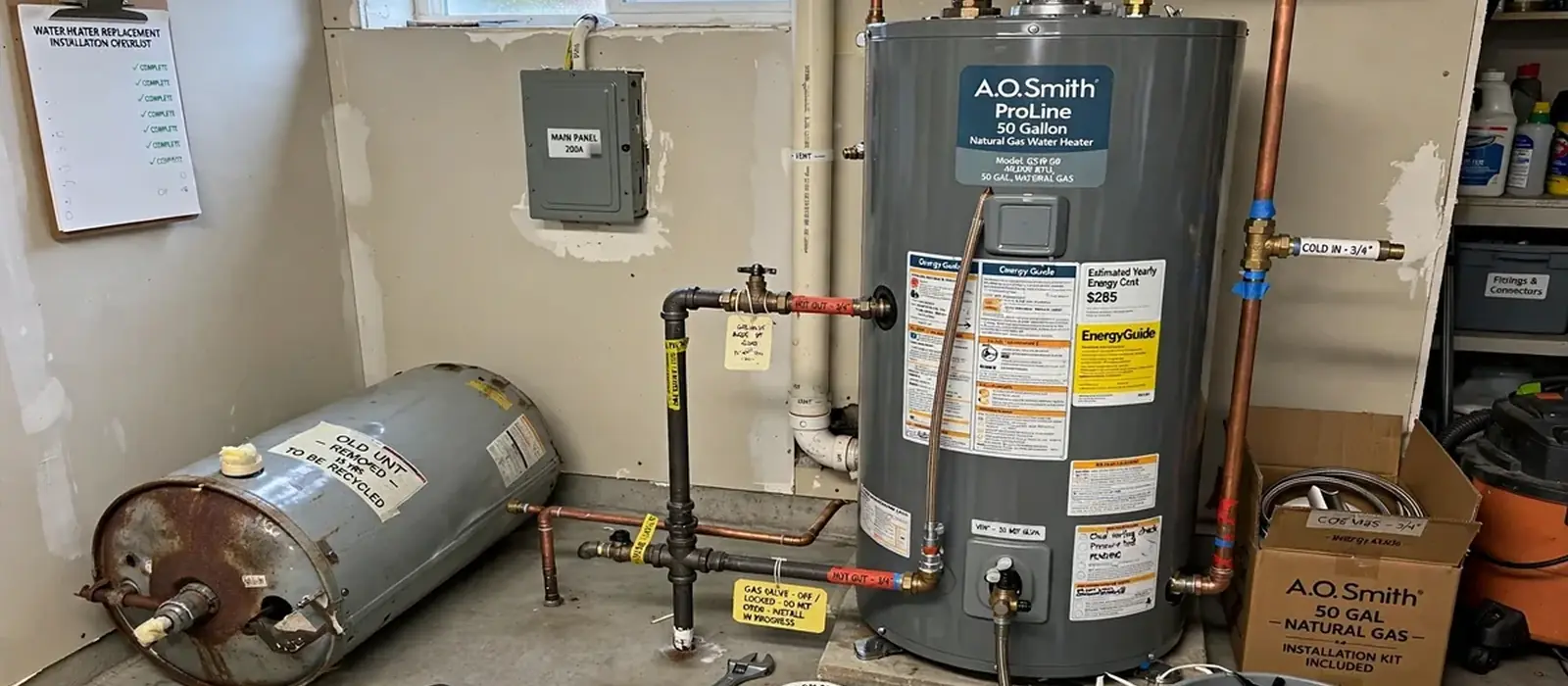
Typical lifespan by heater type
These are the ranges manufacturers and utilities commonly publish. Your water, your usage and your maintenance history can push a unit above or below them.
| Heater type | Commonly published range | What usually ends it | Maintenance that helps |
|---|---|---|---|
| Standard gas or electric tank | About 8 to 12 years | Tank wall corrosion, leaking at the base seam | Anode rod check, annual flush, working T&P valve |
| Tank with a thicker or dual anode | Upper end of the tank range | Same, but later | Replace the anode before it is consumed |
| Tankless gas | About 20 years | Heat exchanger scale, fan or board failure | Descaling flush, clean intake and vent, filter screen |
| Tankless electric | About 20 years | Failed elements or controls | Descaling and element inspection |
| Heat pump water heater | Often compared to a tank, ask the maker | Compressor or fan problems, tank corrosion | Filter cleaning, condensate line kept clear |
A tank that has already passed 10 years is a candidate for planned replacement even if it still heats, because failure at that age tends to be a leak and not a quiet shutdown.
Why a tank water heater wears out
A steel tank is lined with glass and protected by a sacrificial anode rod, usually magnesium or aluminum, that corrodes first so the tank wall does not. Once the rod is eaten down to the core wire, the steel begins to rust from the inside, and pinhole leaks follow.
Sediment is the second wear factor. Minerals settle in the bottom of the tank, and on a gas unit the burner then heats the steel through a layer of scale, which produces popping or rumbling sounds. An annual flush through the drain valve slows this, though a tank neglected for years can have sediment packed too hard to drain.
Warning signs that mean it is time
One symptom on its own is a reason to have the heater looked at. Several together are a reason to plan the replacement before the tank decides the date for you.
- Water pooling around the base of the tank. A leak from the tank body cannot be repaired, and a plumber will usually recommend replacement.
- Rust-colored hot water, but clear cold water. This points at tank or anode corrosion, not the house piping.
- Rumbling, popping or knocking from the tank during a heating cycle, which is the sound of boiling water under sediment.
- Hot water running out much faster than it used to, because sediment is taking up tank volume.
- Rust streaks, scorching or soot near the burner compartment or draft hood on a gas heater. Shut off the gas and call right away.
- A unit over 10 years old with no record of when it was installed. Check the serial number label, since many manufacturers encode the date in it.
Water pooling is the one to treat as urgent. Shut the cold supply valve above the heater, turn the gas control to pilot or the breaker off, and call for water heater replacement.
Heater leaking or past 10 years old?
Call (508) 389-4045 and a dispatcher books the next open plumber. Same-day appointments are offered when a slot is available.
What a plumber checks before calling it
Age alone does not condemn a heater. A short inspection separates a unit with years left from one that is about to leak.
- 1
Read the data plate
The serial number gives the build date, and the label lists capacity, fuel and the temperature and pressure rating.
- 2
Inspect the base and fittings
A flashlight on the tank bottom, the drain valve and the nipples at the top shows seep marks, crusted minerals or rust trails.
- 3
Test the T&P relief valve
The temperature and pressure valve is a safety device. If it is weeping, stuck or discharging, the cause (high pressure, thermal expansion or a failing valve) needs to be found.
- 4
Draw off a sample
Running a few gallons from the drain valve into a bucket shows rust flakes, scale or a sulfur odor that points at anode condition.
- 5
Look at venting and combustion air
On gas units, a plumber checks the draft hood, flue slope and signs of backdrafting, because carbon monoxide risk matters more than age.
Repair or replace at a given age
The decision usually turns on where the problem is and how old the tank is. A simple rule of thumb is that a component repair makes sense on a younger unit and a tank-body problem never does.
Repair usually makes sense when
- The unit is under about 8 years old and the fault is a thermostat, heating element, igniter, thermocouple or relief valve.
- The tank is dry and the anode can still be replaced.
- You want to keep the same fuel type and flue arrangement.
Replace usually makes sense when
- The tank itself is leaking, because the steel wall cannot be patched.
- The unit is past about 10 to 12 years and needs a second repair.
- Repair cost would be a large share of a new unit's price.
- Rust is showing in the hot water or the gas burner area.
Seasonal homes and cottages age differently
Wareham's housing plan describes a large seasonal housing stock and dense summer communities, so many heaters here run only a few months a year. That sounds gentle, but a tank left full and unheated can corrode in the standing water, and a heater left off in a cold, unheated cottage can be damaged by freezing.
Two habits help. If the house will be empty for the winter, drain the tank and shut off its fuel and power as part of a full shutdown, and do not just turn the thermostat low. When the season opens, refill the tank before restoring power, because an electric element fired on an empty tank burns out within minutes.
A seasonal heater might reach its thirteenth calendar year with only a handful of seasons of real use, yet scale and corrosion also build in idle months, so judge it by condition and not only by the hours it ran.
Wareham water and what it means for your heater
Two fire districts supply most Wareham water. The Wareham Fire District draws from gravel-packed wells in the Plymouth-Carver aquifer and adds lime for corrosion control, with a published pH target of 7.0 to 8.0. The Onset Fire District pumps from its own groundwater wells and adjusts pH with sodium hydroxide, also for corrosion control.
In practice, find out which district bills you, since the two systems treat water differently, and keep the water bill handy when a plumber asks about your supply. Homes outside both districts on a private well can have their own mineral and iron issues, which tend to show up as heavier sediment inside the tank.
Source type: Wareham Fire District Water Department and Onset Fire District, via Massachusetts DEP source water assessments
What drives the price of a replacement
A clear price is given before work starts. The number moves with a short list of factors that you can influence by deciding some of them ahead of time.
Hot water out of service is a strain, so ask for a same-day appointment if one is open. Tankless conversions are priced separately, and the tankless water heater page explains what changes in gas line size and venting.
A permit is part of the job
Replacing a water heater requires a plumbing permit, and under 248 CMR 3.05 the permit is issued only to a properly licensed individual. Stopping a leak or clearing a stoppage does not need one, but swapping the heater does. A permit also gets the work inspected, which covers the gas connection, relief valve discharge and vent.
Extending the life of the heater you have
Flush the tank once a year by connecting a hose to the drain valve and running it to a floor drain or outside until the water runs clear. Test the relief valve lever by lifting it briefly while a bucket sits under the discharge pipe. Setting the thermostat near 120 degrees Fahrenheit reduces scale and scald risk.
Ask a plumber to look at the anode rod around year four or five. Replacing it is much cheaper than replacing the tank, provided there is room above the unit to pull the rod, and some installations need a flexible rod for low ceilings. Neighboring towns such as Carver and Marion share the same hot-water habits, and the same advice applies.
What to do if your tank shows warning signs
A few steps reduce damage and risk, and they apply whether or not a plumber is on the way.
- Look at the base of the tank for rust streaks or moisture and check the fittings above it.
- Do not tamper with the temperature and pressure relief valve or cap its discharge pipe.
- If water is pooling, shut off the cold supply to the tank and turn off the power or gas control.
- Call before the tank fails completely, so the replacement can be planned instead of rushed.
Frequently asked questions
A standard tank is commonly replaced at about 8 to 12 years, and a tankless unit at about 20 years with regular descaling. Replace sooner if the tank leaks, since a leaking tank cannot be repaired. Keep a note of the install date so you can plan the change.
Not automatically, but it is living on borrowed time. Past 12 years, the likely failure is a leak that floods the floor, and on gas units a rusted flue or burner area is a safety problem. Have it inspected and plan the replacement.
It can last more calendar years because it runs fewer hours, but corrosion and sediment still build while the tank sits full. Draining the tank for winter and checking the anode each spring helps. Judge it by condition and not just age.
Often yes, if the tank is still sound. The rod is a threaded part at the top, and a plumber can swap it in a short visit. Once the tank leaks, a new anode will not save it.
Yes. Under 248 CMR 3.05 replacement work needs a permit, and it is issued only to a licensed plumber. The town's Inspectional Services office handles the permit and inspection, and Wareham offers an online permitting portal.
Look at the data plate on the tank. Many manufacturers encode the month and year in the serial number, and the maker's customer line can decode it. If the plate is unreadable, treat the heater as older than it looks.