The five things that set the price
Every sewer repair quote is built from the same short list. Knowing the list lets you ask better questions when a plumber hands you a number.
Hours also matter. A planned repair is scheduled on a normal workday, while an urgent backup that needs a crew right away carries after-hours scheduling. Either way the price is quoted first.
Why a camera inspection comes before any quote
A plumber cannot price what they cannot see. A sewer camera inspection sends a waterproof camera head down the line on a push cable, records the footage and marks the distance to each problem with a locator at the surface.
That footage answers the questions that drive cost. Is the pipe cracked, offset at a joint, bellied so water pools, or packed with roots? Is the damage in one spot or along the whole run? You should be shown the video, not just told the result, and the quote should point to specific distances on it.
Trenchless repair or open trench
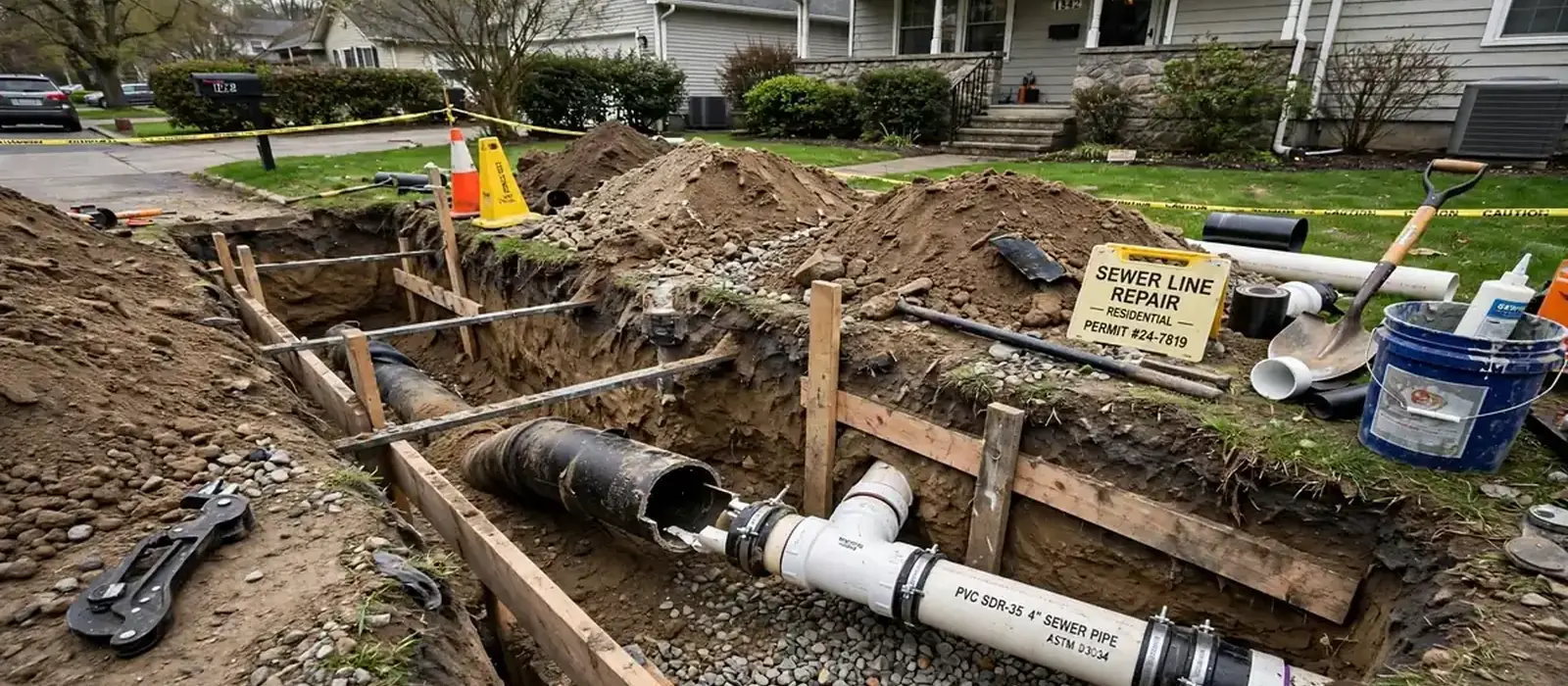
Neither method is always better. The camera findings and the site decide which one fits, and a plumber who only offers one option may be steering you to the work they prefer.
Trenchless (lining or pipe bursting)
- Works through one or two small access pits instead of a full trench
- Leaves driveways, walks and landscaping mostly intact
- Needs a pipe that is not collapsed or badly bellied for lining
- Equipment and materials cost more per foot than a simple dig
- Often finishes in a day once the line is cleaned and mapped
Open trench excavation
- Replaces the pipe with new PVC at a set slope
- Fixes collapsed sections and bellies that lining cannot
- Lets the crew see and correct the bedding under the pipe
- Digging and restoration labor grow with depth and length
- Can be the cheaper path when the run is short and open lawn
Want to know which method fits?
Call the 24/7 line to book a camera inspection. The plumber reviews the footage with you and explains the options before any digging starts.
How the repair types compare on cost drivers
The table shows which factors weigh most for each repair type. It is a map of where money goes, not a price list.
| Repair type | Biggest cost driver | Usually fits | Watch for |
|---|---|---|---|
| Spot repair of one section | Excavation depth at the break | One cracked or offset joint | Hidden damage further down the line |
| Trenchless lining | Cleaning and prep of the old pipe | Cracks and root entry with the pipe still round | Collapsed or bellied sections lining cannot fix |
| Pipe bursting | Access pits at both ends | Whole run in poor shape, clear path | Nearby utilities and shallow neighbors' lines |
| Full open trench | Length, depth and restoration | Collapsed pipe, steep depth changes, short runs | Damage to lawn, paving and trees |
| Cleaning only | Cable or jetter time | Grease or roots with sound pipe | Repeat clogs that signal a real defect |
Sewer or septic changes what you are paying for
Wareham's sewer department runs about 61 miles of gravity pipe and 45 pump stations, but the town's housing plan notes that areas north of Route 25 could not be added to the system. A home on the town sewer has a lateral pipe running to the street. A home on septic has a building sewer running to a tank, and the work and rules on that side are different.
On septic, a slow or backing-up pipe may really be a tank outlet, a distribution box or a leach field problem. Paying for a pipe replacement when the field is failing is money spent on the wrong end of the system, so the diagnosis should cover both. Massachusetts also requires a Title 5 inspection when a septic property is sold, which is a good reason to sort out recurring backups before listing.
If you are not sure who maintains which stretch of pipe on a sewered street, ask the Wareham Sewer Department before you sign anything. Our sewer line repair crews can work out the property side from the camera footage.
What Wareham's sewer system means for your repair
The town's sewer department lists about 61 miles of gravity sewer and 45 pump stations, and its housing plan says expansion north of Route 25 could not be accommodated while high septic-failure areas were prioritized for sewer tie-in. A pump station means some streets rely on force mains and pumped flow, which is one more reason a backup should be traced before digging.
Source type: Wareham Sewer Department and Wareham Housing Production Plan
How a typical repair job unfolds
Knowing the order of work helps you spot a quote that skips a step. Here is the usual sequence.
- 1
Clear and inspect
The line is cabled or jetted so the camera can pass, then inspected end to end.
- 2
Locate and mark
A locator at the surface marks the problem spots and depth, and 811 Dig Safe is called before any excavation.
- 3
Choose the method
You see the footage and the options, and agree on a clear price in writing.
- 4
Permit and repair
Under 248 CMR 3.05 a permit is needed before plumbing is repaired or replaced, and it is pulled by a licensed plumber. Ask the Wareham inspectional services office about local rules.
- 5
Test and restore
The line is flow tested or re-scoped, and lawn, paving or flooring is restored as quoted.
Questions to ask before you accept a quote
A good quote can answer every item here. A vague one usually cannot.
- Was a camera inspection done, and can I see the footage?
- Which method is proposed, and why not the other one?
- How many feet of pipe will be repaired or replaced?
- Does the price include permits, restoration and disposal of spoil?
- What is the plan if the dig reveals more damage than the camera showed?
- Who is responsible if a buried utility is hit, and who calls 811?
Roots and age are the usual culprits on older lines. Wareham's median home dates to about 1969 and roughly one in five predates 1939, so cast iron, clay and Orangeburg-type fiber pipe turn up often. Each of those fails differently, and the method depends on which one the camera finds.
Cheaper now is not always cheaper later
A spot repair on a pipe that is failing along its whole length buys a few months and a second dig. A full replacement on a pipe with one bad joint spends money that did not need to be spent. Matching the repair to the real extent of damage is how total cost stays low.
Insurance often treats a gradual sewer failure as maintenance rather than a covered loss, and a sewer backup is frequently a separate optional endorsement. Ask your insurer before work begins and keep your inspection video, since it documents the cause and date.
Nearby towns follow the same logic
The same method-depth-access-restoration logic applies if you own property in Carver, where homes rely on their own septic systems, or Marion, which has a town sewer network and about a third of developed properties on septic. Before choosing a plumber for any of them, compare the scope in each quote instead of the bottom line.
Frequently asked questions
It depends on the method, depth, length, access and restoration, so no honest figure exists before a camera inspection. After the inspection you get a clear price in writing before any work begins.
No. Trenchless saves restoration work, but lining costs more per foot and does not fit collapsed pipe. On a short run in open lawn, a simple trench can be the lower total.
It is a separate scope of work, and the footage is what makes an accurate quote possible. Ask the plumber to confirm in advance whether the inspection fee is credited toward the repair.
The answer depends on where your property responsibility ends and the town main begins. Call the Wareham Sewer Department to confirm before assuming either side owns the repair.
Under 248 CMR 3.05 a permit is generally required before plumbing is repaired or replaced, and it must be pulled by a licensed plumber. Clearing a stoppage alone does not need one.
Yes. The line runs to a tank rather than to a street main, and the tank, distribution box and leach field should be checked too. A Title 5 inspection is required when the property is sold.