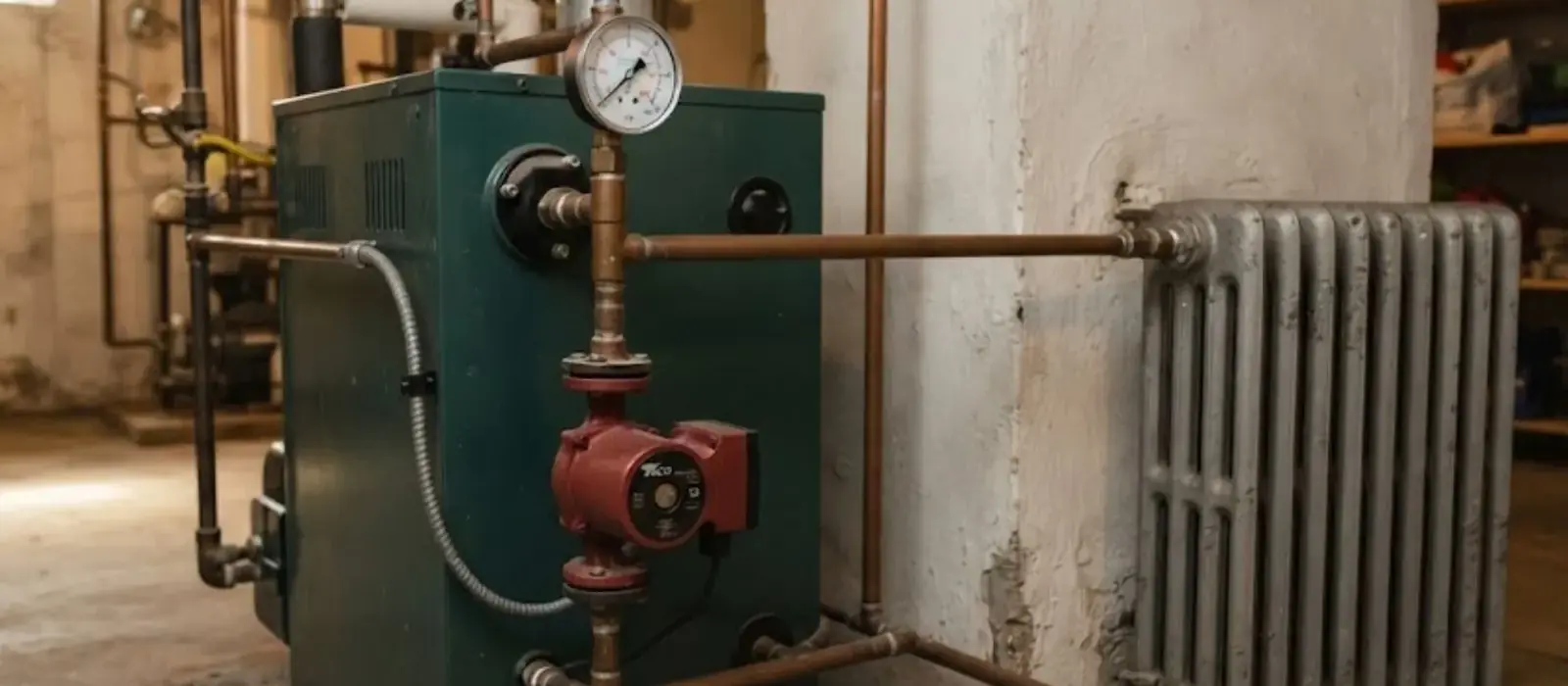
First steps when you find water around the boiler
These steps apply to any boiler type. None of them require opening the boiler.
- Turn off the boiler at its emergency switch, usually a red-plate switch at the top of the cellar stairs or on the boiler itself. Do not rely on the thermostat.
- Look at the source before you wipe anything. Dry the floor, then watch for the first drop and note where it forms.
- If the water is hot or the pipe is steaming, keep clear. Boiler water can scald, and a steam leak does not look as bad as it is.
- Close the cold water feed to the boiler if you can find it, a small valve on the pipe entering the boiler. Stopping the feed stops the supply of new water to the leak.
- If water has reached the burner, controls or wiring, leave the power off and call. Wet controls and a gas burner do not mix.
Gas or oil boilers add one more rule. If you smell gas or see soot around the burner, leave the house and call the gas company from outside.
Hot water boiler or steam boiler
Most homes in the area have one of two systems, and the leaks differ. Knowing which you have makes the phone call much shorter. If you see radiators with a single pipe and a small vent on the end, you most likely have steam. If you see baseboard pipes or radiators with two connections, it is likely hot water.
Hot water boiler
- Water circulates through a closed loop, pushed by a circulator pump
- Runs with a water pressure of roughly 12 to 15 psi cold on the gauge
- Common leaks: circulator flange, relief valve, expansion tank, air vents, radiator valves
- A steady drop in pressure means water is escaping somewhere
Steam boiler
- Water in the boiler boils into low pressure steam that rises to the radiators
- A sight glass on the side shows the water level
- Common leaks: gauge glass gaskets, low water cutoff, radiator valve packing, return piping
- Condensate returns to the boiler, so a sudden need to add water suggests a hidden leak
Where leaks start on a hot water system
Hot water boilers have a handful of parts that wear out, and each has a signature.
Circulator flange
The pump bolts to the piping with a pair of flanges and gaskets. A drip at the joint means a failed gasket. It is a small part but it needs the loop isolated or drained to replace.
Pressure relief valve
A valve on the boiler that opens when pressure goes too high, usually at 30 psi on residential units. If it drips or discharges steadily, the cause is often a failed expansion tank or an overfilled system, not the valve alone.
Expansion tank
A tank with an air cushion absorbs water expansion. If the diaphragm fails, pressure spikes and the relief valve weeps. The tank feels full of water when tapped.
Boiler body or sections
Water seeping from between cast iron sections or the base is serious. It usually means the heat exchanger has cracked, and the boiler is at the end of its life.
Why the relief valve is the one to respect
The pressure relief valve is the safety device that keeps pressure inside the boiler from climbing past what the vessel can take. If it is leaking or discharging, never cap it, plug it or tighten it down. Doing so removes the one thing preventing overpressure.
A discharge pipe should run to within a few inches of the floor so any release is visible and safe. If you find this pipe dripping, a plumber needs to find out why pressure is rising. Replacing the valve alone, without checking the expansion tank and the fill valve, often brings the drip back within weeks.
Boiler leaking and the house is cold?
Switch the boiler off, then call. We book a licensed plumber and explain the price before any work begins.
Steam boiler leaks and the low water cutoff
A steam boiler depends on its water level. The low water cutoff is a control that shuts the burner down if the level falls too low, and a boiler that fires dry can crack its sections. If the sight glass shows an empty or very low level, shut the boiler off and leave it off.
A steam system loses a little water as steam escapes through vents. A sudden need to add water every few days points to a leak in the return piping, often buried in a basement slab or behind a wall. A plumber can pressure test sections of the piping to find it, and leak detection methods such as listening gear help locate a buried run. The repair may be a short piece of pipe or a bigger job.
Leak, likely cause, and who should fix it
Some items are homeowner checks. Most are a licensed plumber's work, because they involve pressure, gas and combustion controls.
| What you see | Likely cause | Safe to try | Call a plumber for |
|---|---|---|---|
| Slow drip at a radiator valve | Worn valve packing | Snug the packing nut a quarter turn | Valve replacement, which needs the system drained |
| Drip at the pump | Failed flange gasket | Nothing, keep the power off | Gasket or pump replacement |
| Relief valve discharges | Overpressure or failed expansion tank | Check the gauge, then shut off the feed | Diagnosing pressure and replacing parts |
| Puddle under the boiler body | Cracked section or failed seal | Nothing | Assessment of repair against replacement |
| Rust stains on a steam pipe | Pinhole leak in return piping | Mark the spot and keep the area dry | Pressure test and pipe repair |
Boilers in older Wareham houses
Wareham's housing plan puts the median home at about 1969 construction, and roughly one in five homes were built before 1939. In houses of that age, a boiler can be decades old and paired with cast iron radiators or buried return lines. That mix makes a small leak more likely to be a symptom of aging parts than a one-off.
Wareham also has a large seasonal housing stock. A cottage heating system that is shut down for months and not drained correctly can freeze and split a pipe, so a spring check of a seasonal boiler should include looking for new drips before firing it.
Source type: Wareham Housing Production Plan, mass.gov
What drives the price of a leaking boiler repair
A clear price is given before work starts. These are the real factors behind it.
If the repair bill is approaching the value of the boiler, ask the plumber to talk through repair versus replacement openly. A good plumber will say when a repair is not worth it.
When to shut the system down and keep it off
Leave the boiler off if there is a steady stream of water, if the relief valve is discharging repeatedly, if the sight glass is empty, if the boiler body is wet, or if there is any smell of gas, oil or burning. A running boiler with a leak can lose its water and overheat.
Plumbers from the same dispatch serve Marion and Rochester as well as Wareham, so a call placed at night reaches the next open licensed plumber. Permits are pulled by a licensed plumber under 248 CMR 3.05, and permit rules vary by job, so ask the Wareham Inspectional Services Department about yours. For anything related to the burner, the gas train or the flue, only a licensed professional should touch the system.
Water on the cellar floor?
Tell the dispatcher what you see and where it is coming from. Same-day appointments are offered when a slot is open.
Frequently asked questions
It can be. Hot water scalds, wet controls can short, and a leak that drops the water level can let the boiler overheat. Switch it off at the emergency switch, shut the cold feed and call.
Usually the system pressure is too high, because the expansion tank has lost its air cushion or the fill valve is letting in too much water. Sometimes the valve itself is worn. A plumber checks the gauge and tank before replacing the valve.
A tiny weep at a radiator valve can wait a day or two with a pan under it. A leak at the pump, relief valve or boiler body should not wait. If you must keep heat on during a cold night, ask the dispatcher whether it is safe for your system.
Look for a sight glass on the side of the boiler and a pressure gauge that reads low pressure. Steam systems usually have radiators with one pipe and a vent on the end. Hot water systems have a circulator pump and a gauge that reads in the 12 to 15 psi range when cold.
A system that sits unheated can freeze, and winter movement can open a joint. Another common cause is a gasket that dried out while the boiler was idle. A plumber can pressure test the loop before you fire it for the season.