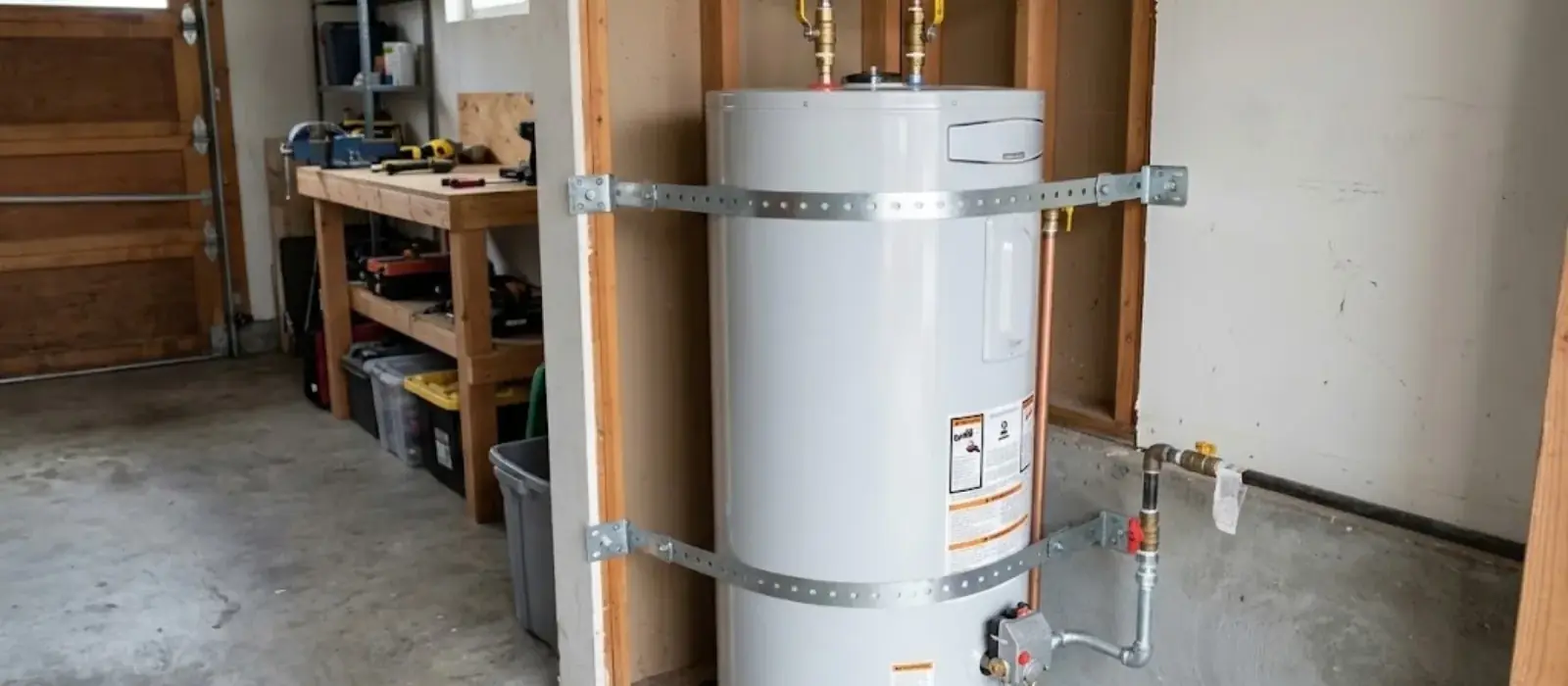
Difficulty by water heater type
Difficulty here means how many things can go wrong, not how heavy the unit is. Each row lists what the installer has to get right.
| Type | Difficulty | What has to be right | Main risk |
|---|---|---|---|
| Electric tank | Moderate | 240 volt wiring, shutoff, relief valve piping, full tank before power | Electric shock and dry firing the elements |
| Gas tank, atmospheric vent | Hard | Gas connection, draft hood, flue pitch and clearances | Carbon monoxide and gas leaks |
| Power vent tank | Hard | PVC vent run and slope, outlet, gas connection, condensate or drain | Poor vent sealing and exhaust re-entry |
| Tankless gas | Very hard | Gas line size, stainless or PVC vent, condensate, valve set | Underfed gas supply and vent failure |
| Tankless electric | Hard | Large dedicated circuits, panel capacity | Overloaded panel and wiring |
The electric tank swap
An electric tank is the closest to a homeowner project. You shut the breaker, close the cold supply, drain the tank, disconnect the pipes and wires, and reverse the process with the new unit. Two people and a hand truck handle the weight.
The traps are real, though. Powering the new tank before it is full burns out the elements in seconds, and a missing or poorly piped temperature and pressure relief valve discharge is a scald hazard. The relief valve drain line must run downward to a safe spot, not capped or routed up.
Why gas and power vent are a different category
A gas tank burns fuel, and the exhaust must leave the house. Atmospheric units use a draft hood and a metal flue that relies on rising hot air. If the flue pitch is off or the connector is loose, the exhaust can spill into the room, and a cold basement can pull it back down. Carbon monoxide is odorless.
A power vent uses a fan to push exhaust through PVC, which allows a long horizontal run to an outside wall. That adds an outlet, vent sealing and a termination that must clear windows and meter areas. In both cases the gas connection is tested for leaks before the pilot or burner lights, and that is gas fitter work.
Water heater gone and you need a swap?
Call and a dispatcher books a licensed plumber. The permit and the price are covered before work starts.
What a proper replacement involves
Here is the sequence a plumber follows. You can see why the licensed part matters.
- 1
Permit and sizing
A licensed plumber applies for the permit, and checks the old unit's size, fuel and venting against what is being installed.
- 2
Shut down and drain
Fuel and power are off, the cold supply is closed, and the tank is drained to a floor drain or outside.
- 3
Disconnect and remove
Pipes, gas line, vent connector and wires come off. A tank full of sediment can weigh more than expected.
- 4
Set the new unit
It sits level on a stand or pan, with the relief valve and discharge pipe, dielectric nipples where dissimilar metals meet, and a thermal expansion tank if the system calls for it.
- 5
Connect fuel and vent
The gas line gets a new flex connector and a leak test. The vent is pitched, sealed and checked for draft.
- 6
Fill, test and inspect
The tank is filled before it is lit or powered. Combustion is checked, then the inspector signs off.
The tankless swap is not a bigger tank
Moving from a tank to a tankless unit is a redesign, not a replacement. Tankless gas units draw a lot of gas at once, so the existing line may be too small, and the old flue is often the wrong material.
Non-condensing units vent in stainless steel. Condensing units vent in plastic and need a condensate drain. A pipe, vent and gas change in one job is why tankless belongs with a professional.
Permit rules and where to ask in Wareham
Under 248 CMR 3.05, a permit must be issued before plumbing or gas work is installed, altered, removed, replaced or repaired. The application is in writing before work starts, and permits go only to properly licensed individuals, not to apprentices or homeowners. A permit lapses if work does not start within 90 days.
In Wareham the Inspectional Services Department at Memorial Town Hall, 54 Marion Road handles plumbing and gas permits, with an online portal. The state rules also allow a licensee to start an emergency repair and notify the inspector, with inspection no later than the next working day. That is why a failed tank on a cold night can still be handled quickly.
Source type: mass.gov 248 CMR 3.05 and Town of Wareham Inspectional Services
Questions to ask before you hire or before you try it
Whether you hire out or not, these decide how the job goes.
- Who pulls the permit, and will the inspector sign off. This is a licensed plumber's job, so ask for the licence on the permit.
- What fuel and venting does the new unit need, and is the old flue or vent run still suitable.
- Does the tank size match the household. Undersizing causes cold showers, and oversizing wastes fuel.
- Is a new expansion tank, relief valve and discharge pipe included in the quote.
- Is the old tank hauled away, and is the final price stated before work begins.
Look up the licence on the state lookup for Plumbers and Gas Fitters. It takes a minute.
What makes one swap harder than another
Conditions in your house change the difficulty more than the heater model.
Wareham has older housing, with a median build year near 1969 and about one in five homes from before 1939, so expect surprises in the piping around a decades-old tank.
Where to go from here
If your tank has failed or is leaking at the seams, water heater replacement covers the emergency swap. If you are planning a new setup or a switch to another type, water heater installation is the planned-job route.
The same dispatch covers Bourne and Middleborough as well, so you are not limited by town line. Call and a licensed plumber will talk through your setup.
Want to know what your swap would involve?
Describe your heater and the dispatcher books a licensed plumber. Same-day appointments are offered when a slot is open.
Frequently asked questions
The permit must be issued to a properly licensed individual under 248 CMR 3.05, so a homeowner cannot pull it. In practice a licensed plumber does the work and gets the inspection.
A same-size electric tank in an accessible spot. Even that carries shock and scald risks, and the permit rule still applies.
It involves a gas connection and exhaust. A loose joint leaks gas, and a bad flue lets carbon monoxide into the house. Both need testing with proper instruments.
Yes. It usually needs a larger gas line, special venting and often a condensate drain or valve set for flushing. It is a design job, not a swap.
The state rules allow a licensee to start an emergency repair and notify the inspector, with inspection by the next working day. Call the 24/7 line and a dispatcher books the next open plumber. Same-day appointments are offered when a slot is open.