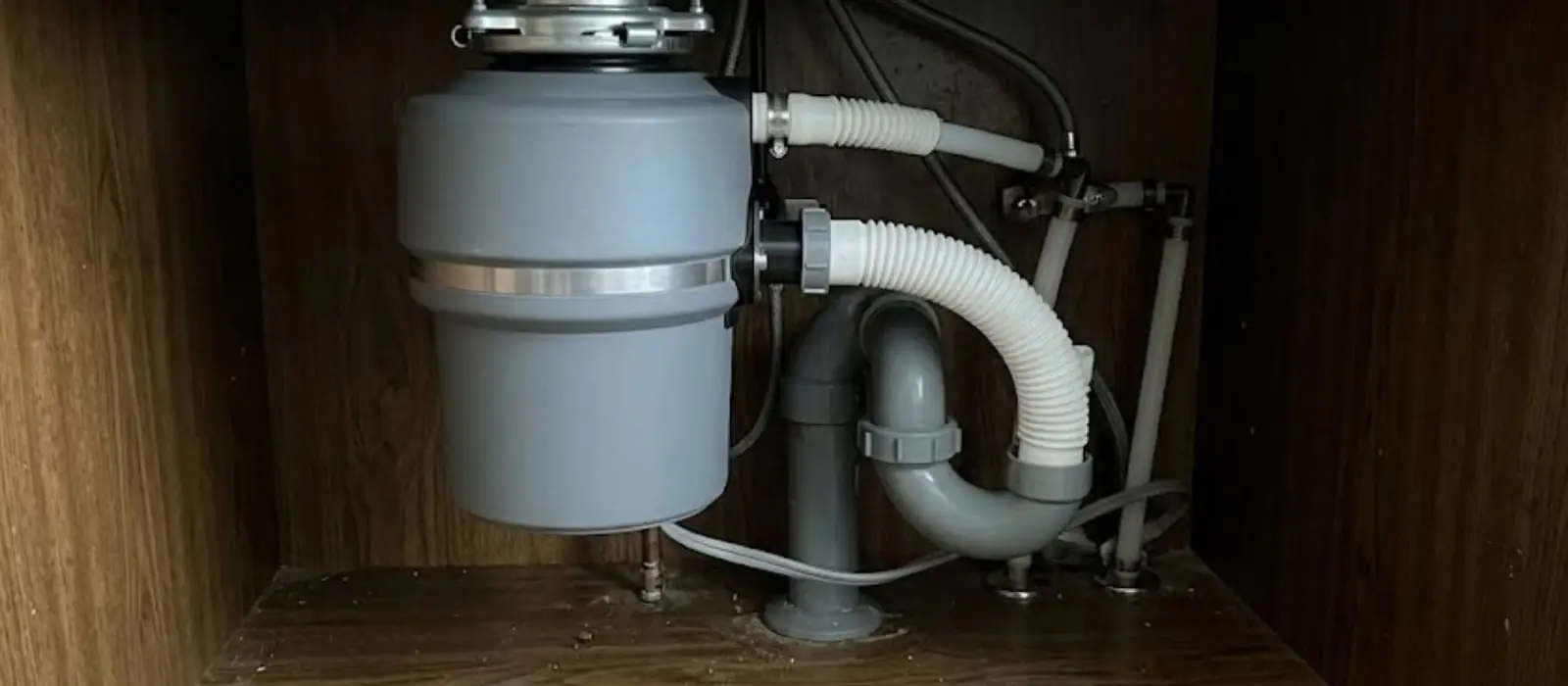
What moves the price of a disposal install
The unit itself is only part of the bill. Labor changes with what is already under the sink, and an ordinary swap is a different job from a new install.
Brand, noise insulation and a sound-reduced motor mount also change the unit price. A clear price is quoted before work starts, based on what you describe and what the plumber sees on arrival.
Horsepower: how much is enough
A one-third or one-half horsepower unit handles scraps from a household that cooks a few meals at home. Three-quarters and one horsepower models spin faster, jam less and handle tougher scraps like small bones and fibrous vegetables, though no disposal replaces a trash can.
A larger motor does not clear a bad drain. If water backs up through the unit, the cause is usually a clogged trap or branch line, not the disposal, and a plumbing installation visit can include correcting an undersized or flat drain run at the same time.
Continuous feed or batch feed
Both types grind food the same way. The difference is how they start, and that choice changes cost, wiring and safety.
Continuous feed
- Starts with a wall switch or an air-switch button.
- Common, lower unit price and widely stocked.
- Lets you feed scraps while the unit runs.
- Needs a switched outlet or hardwired circuit under the sink.
Batch feed
- Starts only when the stopper lid is twisted into the flange.
- Higher unit price and fewer models.
- Keeps hands and utensils away from the grinder.
- Often avoids a wall switch, which can save wiring when none exists.
Want a disposal installed?
Call (508) 389-4045 and describe the sink, the dishwasher and the outlet. A plumber can then tell you what the job involves.
What an installation visit looks like
A swap takes less time than most homeowners expect, but the order matters. Each step below protects a joint or a circuit that is easy to get wrong.
- 1
Shut off power and water
The breaker feeding the disposal is switched off and tested, and the sink supplies are closed if the trap will be removed.
- 2
Remove the old unit
The mounting ring is twisted free, the discharge tube and dishwasher hose are disconnected, and the unit is lowered out.
- 3
Prepare the sink flange
Old plumber's putty is cleaned off and the flange is reset with fresh putty or a gasket, with the mounting assembly tightened evenly.
- 4
Hang the new unit
The disposal locks onto the mounting ring. If a dishwasher is present, its inlet knockout is punched out before the hose goes on.
- 5
Connect drain and power
The discharge tube joins a trap with a proper slope, and the cord or wiring goes into a grounded, switched supply.
- 6
Test for leaks
Water runs for several minutes while the plumber checks the flange, dishwasher hose and trap for drips.
Questions that sort out the price on the phone
Having these answers ready makes the price discussion shorter and more accurate.
- Is there already a disposal, or is this a first-time install?
- Is there an outlet or switch under the sink, and is it a plug-in or a hardwired connection?
- Does the dishwasher drain into the disposal, or through an air gap or high loop at the sink?
- Is the sink a double bowl, a single bowl or a farmhouse style, since some old flanges do not fit new mounts?
- Do you rely on town sewer or a septic system?
- Is the existing trap plastic or metal, and is it leaking or slow?
Septic homes: think before you add a disposal
Disposals add ground food to the waste stream, which increases solids in a septic tank. Many manufacturers and health agencies advise septic owners to use a disposal sparingly or not at all, and a tank may need more frequent pumping if one is added.
Wareham's housing plan notes that areas north of Route 25 could not be added to the sewer system, so many homes in town rely on septic. Ask your septic inspector or the Board of Health before adding a disposal, and keep grease and coffee grounds out of the sink either way.
Sewer or septic in Wareham matters here
The Wareham Sewer Department operates about 61 miles of gravity sewer pipe and 45 pump stations, and the town has reported a major upgrade to its wastewater treatment facility. Properties on that system send food solids to a treatment plant, so a disposal is less of a burden than on a septic tank.
For homes on septic, Massachusetts requires a Title 5 inspection when the property is sold. An inspector looking at the tank sees whether solids are building up, which is one more reason to talk to the inspector before adding grinding load.
Source type: Wareham Sewer Department page and Wareham Housing Production Plan
Install-day situations and what changes
These examples show how the same disposal can be a quick job or a bigger one depending on what is under the sink.
| Situation | What the plumber does | What affects the price |
|---|---|---|
| Replacing an old unit with an outlet in place | Swaps the unit, reuses the mount if compatible | Unit choice, mount style, labor |
| Replacing a unit, old flange is corroded | Pulls and resets the sink flange | New flange and putty, possible sink seal work |
| First-time install, no power under sink | Plumber installs, electrician adds a switched circuit | Electrical work and any permit |
| Dishwasher connected to the drain | Removes the knockout and connects the hose with a high loop | Added hose, clamp and time |
| Old trap leaking at the wall | Replaces the trap and tailpiece | Parts, access and wall condition |
When the old disposal can be repaired instead
If the unit hums but will not spin, it may only be jammed, and a hex key in the bottom socket often frees it. A reset button on the base trips after overload. A leak at the top flange or dishwasher inlet is often a seal or clamp, and garbage disposal repair is the right route in those cases.
Replacement makes more sense when the housing is cracked, the motor shorts the breaker, or the unit leaks from the body seam. A body leak cannot be sealed, and a disposal that is over about 10 years old is usually not worth another repair.
Local note for Wareham homeowners
Is a permit part of a disposal install?
Permit rules vary, so ask Wareham Inspectional Services before you start. 248 CMR 3.05 requires a permit before plumbing work is installed, altered or replaced, but the exemptions are narrow, which is one more reason to have a licensed plumber confirm the rule for your swap.
Frequently asked questions
The total depends on horsepower, feed type, whether an outlet already exists and what the dishwasher and trap connections need. A straight swap is the simplest job, and a first-time install with new wiring is the most involved. A clear price is given before work starts.
If you are comfortable with plumbing and an existing switched outlet, many units are designed for it. Power must be off at the breaker, and the dishwasher knockout, mounting ring and trap need correct assembly. A leak under the sink can ruin a cabinet floor, so many owners hire a plumber.
Only if there is no switched outlet or hardwired circuit at the sink base. A plug-in unit needs a grounded receptacle, and a hardwired unit needs a junction box and switch. Adding a circuit is electrical work and may need its own permit.
It can add solids to the tank, so many septic owners use one sparingly or skip it. Parts of Wareham north of Route 25 could not be added to the sewer system, so septic is common. Ask your septic inspector or the Board of Health before you install.
The knockout is a plastic plug inside the disposal's dishwasher inlet. If it is left in place, the dishwasher drain hose cannot empty and water backs into the dishwasher. It is removed with a screwdriver and a hammer before the hose is attached.
Many disposals run for around 8 to 12 years depending on use, horsepower and what goes into them. Frequent jams, a rusty body or leaks from the housing are signs the unit is near the end.
Permit rules vary, so ask the Wareham Inspectional Services office, which handles plumbing and electrical permits. Wiring changes are covered by the electrical side, and a licensed plumber knows when plumbing work requires one.