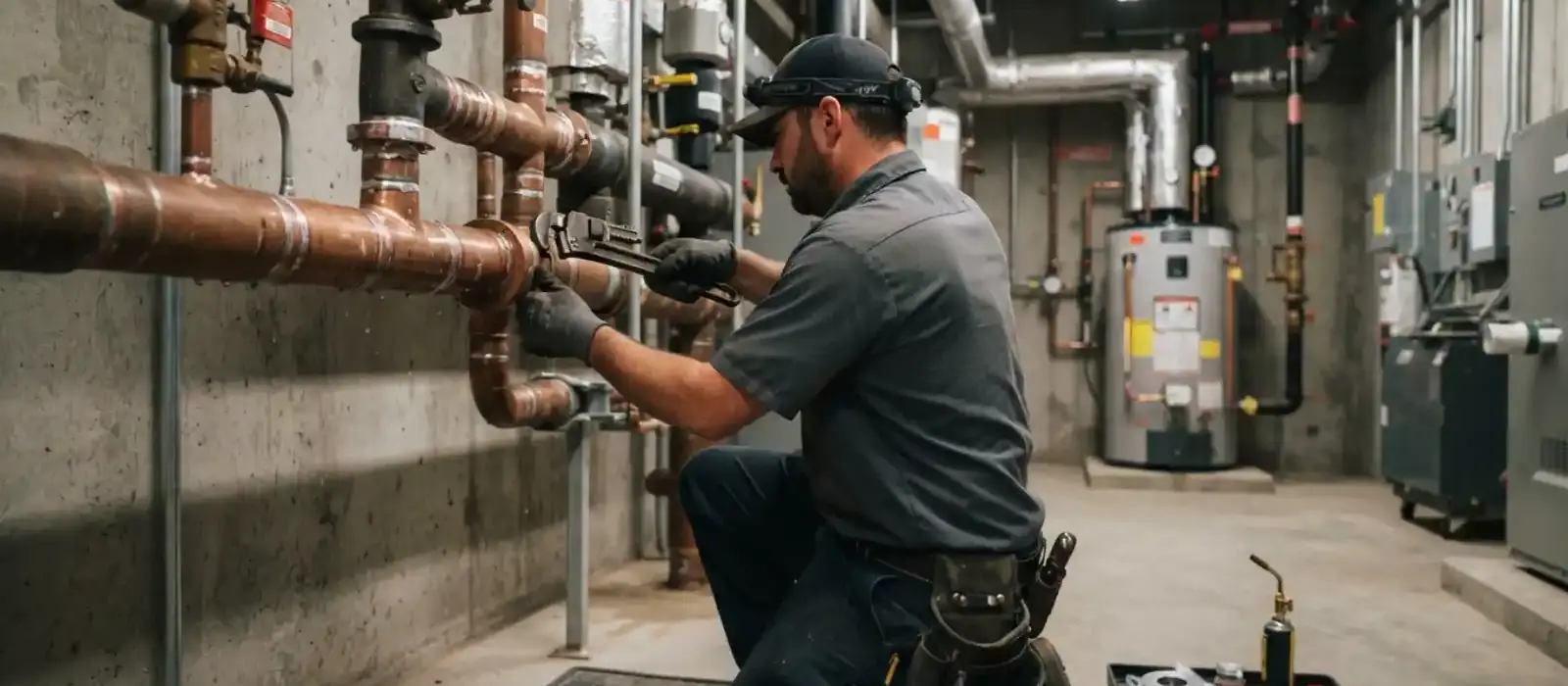
When a commercial plumbing problem is an emergency
A business can usually wait out a dripping tap. It cannot wait out the situations below, because they stop service, risk a health code issue or damage the building.
- Sewage or gray water is backing up from floor drains, a three-compartment sink or restroom fixtures. Close the kitchen or the restrooms until it is cleared.
- A burst or leaking supply line is soaking a ceiling, stock or electrical gear. Shut the main valve and keep people away from wet outlets.
- The grease interceptor or floor sinks are overflowing during service. Stop dish and prep water at once.
- A flushometer valve on a toilet or urinal will not stop running, or the restrooms have no water at all.
- Hot water is gone in a food-service space that needs it for dish machines and handwashing.
- A seasonal or waterfront building has water coming from a pipe that froze or sat unused since fall.
Tell the dispatcher what the business does, how many floors or units are involved and where the shutoffs are. That tells us which tools and parts to load, and it sets the order of repair.
Restaurants, kitchens and grease interceptors
A commercial kitchen sends grease, starch and food solids down the line all day. A grease interceptor, which sits under the floor or in the yard, slows the water so fat floats and solids settle, but once it is full, that waste flows on to the building drain. The usual sign is slow floor drains, a sour smell and sinks that back up at the end of a rush.
We clear the lines with a cable or a hydro jetting nozzle, locate the blockage and tell the owner whether the problem is the building line or the interceptor. Pumping and hauling the interceptor is a separate service, and the town sewer department or the water district can say how often the property needs it.
Business down after hours?
Call the 24/7 line, describe what is flooded or out of service and ask for the next open plumber.
Fixtures and systems we work on
Commercial plumbing differs from residential work in pipe size, flow and how many people use it at once. These are the systems that fail most often.
Flushometer valves
The diaphragm and the stop inside a commercial toilet or urinal valve wear out. A valve that runs or sticks wastes water and can overflow the bowl.
Floor drains and floor sinks
Strainers clog with debris. A trap that loses its water seal lets odors into the building, so we check priming and trap depth.
Grease interceptors
Baffles, lids and outlet tees fail with age. We inspect the unit's inlet and outlet and clear the lines feeding it.
Backflow preventers
Devices on irrigation, boiler feeds and fire lines keep dirty water from flowing back into the supply. Failed units leak at the relief port.
Water heaters and mixing valves
Food-service spaces need steady hot water. We repair or replace tank and tankless units, and set mixing valves for safe delivery.
Sump and sewage ejector pits
Below-grade restrooms and basements rely on pumps. A failed pump or stuck float means an overflow into the lowest floor.
Common calls by type of business
Each type of business brings its own pattern of problems. This table shows how we approach a few of them.
| Business | Usual problem | First step | Follow-up |
|---|---|---|---|
| Restaurant | Grease backup, slow floor drains | Cable the line and check the interceptor | Jetting or a camera look if it repeats |
| Small retail or office | Restroom leak, running flushometer | Isolate the fixture and repair the valve | Check the rest of the restrooms for the same age of parts |
| Marina or boatyard | Supply line damage, hose bib leaks, frozen lines | Shut the section, open drains and test | Insulation and drain-down plan for the offseason |
| Seasonal waterfront shop | Spring opening leaks, dried traps | Pressure test lines before opening | Replace failed stops and flush the system |
| Rental or multi-unit | Tenant call about a leak or no hot water | Isolate the unit and repair | Report to the property manager |
The Cranberry Highway corridor and Wareham's waterfront
Cranberry Highway is the stretch of US 6 and MA 28 that carries traffic through West Wareham and toward Buzzards Bay and the Cape bridges. Businesses along it range from retail and food service to offices, and depending on the lot a building may be tied to town sewer or run its own septic system. That matters for a restaurant, since a septic system with a busy kitchen needs a different grease plan.
Wareham also sits at the head of Buzzards Bay, and during Hurricane Bob in 1991 the surge at Onset, Bourne, Mashpee and Wareham reached 12 to 15 feet according to the National Weather Service. That history is one reason waterfront and low-lying commercial buildings should have a working sump or ejector pump and a backwater valve on the sewer lateral.
Water on the kitchen floor during service?
Close the main to the space, stop the dish machine and ask the dispatcher for a same-day slot.
Seasonal businesses: opening and closing checklist
Wareham has a large seasonal housing stock, and many shops, eateries and marina buildings run on the same calendar. Closing and opening the plumbing correctly prevents the callouts that arrive on the first warm weekend.
- Before closing, drain supply lines and fixtures, blow out irrigation and outdoor lines and add non-toxic antifreeze to traps if the building will be unheated.
- At opening, turn the main on slowly with every faucet closed, then walk the building looking for wet spots, dripping stops and weeping unions.
- Run each floor drain and fill each trap with water so sewer gas does not enter.
- Test the water heater, the relief valve and any mixing valve before the first guests arrive.
- Ask for a test of backflow devices on irrigation and boiler feeds, since the local rules for testing vary by water district.
A licensed plumber can walk through the building on a single visit and fix what the checklist finds. That beats finding the weak spot when a pipe lets go in the dining room.
What affects the price of commercial plumbing
A commercial job is priced after the plumber has seen the problem, and you hear the number before work starts. The factors below do most of the moving.
Not every call ends in a sale. If the problem is the building owner's responsibility, or a utility-side issue in the street, we tell you so rather than charge for work that will not solve it.
Landlords, property managers and related work
If you manage a building for an owner or tenants, give us the unit, a contact for access and the approval limit when you call. For a hidden leak we use leak detection before opening any wall, and a ruptured line is handled as burst pipe repair. Businesses along the corridor toward Buzzards Bay can also reach us through our Bourne coverage.
What to do before the plumber arrives
A few steps reduce damage and risk, and they apply whether or not a plumber is on the way.
- Stop the water to the affected fixture or line at its own shutoff, or at the building main if you cannot find it.
- Keep staff and customers away from standing water near equipment, outlets and cooking lines.
- Do not run a floor drain or grease line that is backing up, and do not pour chemicals into it.
- Write down when it started and what was running, so the plumber can trace the cause faster.
Frequently asked questions
Yes. The line is answered 24/7 for restaurants, shops, offices and waterfront buildings. A licensed plumber is booked for the next open slot, and the price is explained before the repair begins.
Restaurants, small retail, offices, rental properties, marinas and seasonal waterfront businesses in Wareham, Onset and along the Cranberry Highway corridor.
We clear the drain lines that feed and leave the interceptor, and we tell you what condition the unit appears to be in. Pumping and hauling is a separate service, so we point you to it when the unit is full.
It is the large diaphragm valve on a commercial toilet or urinal. The rubber diaphragm and the stop wear out or collect debris, so it runs on or fails to flush. Repair kits are common, and replacement follows if the body is worn.
We repair and replace the devices. Annual testing rules vary by water district and town, so confirm the requirement with the water district and Wareham Inspectional Services before scheduling.
Often yes. Tell the dispatcher when the space is clear, and we plan the visit for that window. Emergencies are handled right away.
A licensed plumber pulls it. Under 248 CMR 3.05 permits are issued only to licensed individuals, and a repair to a faucet, valve or fixture part does not need one. Wareham Inspectional Services confirms what applies.