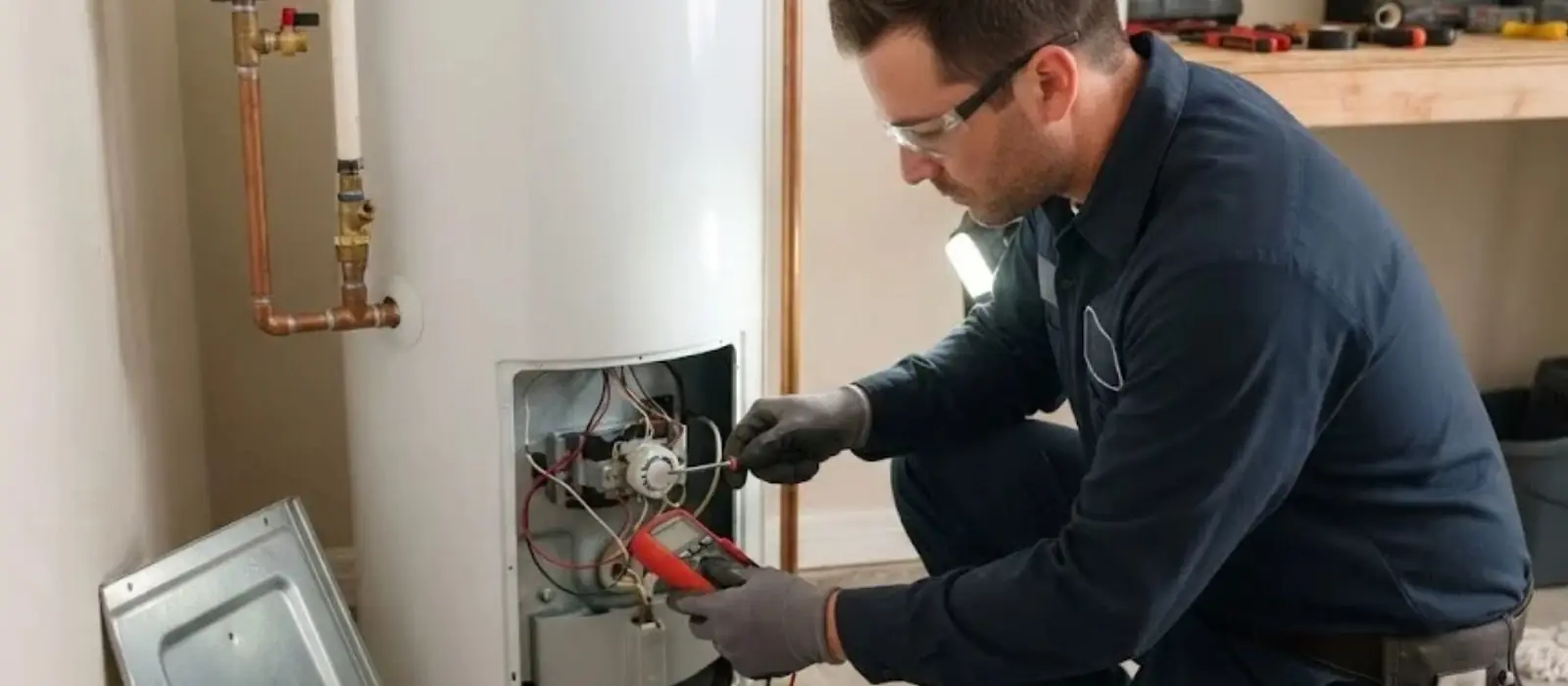
Why the tank cannot stay full
A standard electric tank has two heating elements, one high on the tank near the upper thermostat and one low near the bottom. Each is a threaded or bolted-in rod that sticks straight into the water, sealed by a rubber gasket. When you unscrew it, the seal goes with it.
Even a half-full tank puts water over the upper element, so the draining has to be planned. For the upper element, you can often drain a few gallons and stop once the water level is below the opening. For the lower element, you are draining most of the tank. Anyone who tells you to just work fast with a bucket is asking for a scald and a wet floor.
Test the element before you buy one
Elements fail in two ways. They burn open, so no current passes, or they short to the metal sheath, which trips the breaker. A multimeter set to ohms finds both. This part does not need any draining.
- Turn off the double-pole breaker for the water heater, then confirm with a non-contact voltage tester at the thermostat wires. Do not trust the label on the panel.
- Remove the access panel and push aside the insulation. Take the plastic cover off the thermostat. Note which wire goes where, or take a photo.
- Disconnect one wire from each element terminal. A live circuit or a second connected wire will give a false reading.
- Set the meter to its lowest ohms range and touch the probes to the two element screws. A working element reads a low number of ohms. A reading of OL, infinity, or no movement means the element is burned open.
- Touch one probe to a terminal and the other to the bare metal of the tank or the element's mounting flange. A good element reads open. Any reading at all means it has shorted to ground and it must be replaced.
Always test both elements. If the top one is open, the water will run cold even though the lower one is fine. If the lower one is open, you get a small amount of hot water at the top of the tank, then it runs out fast.
What the symptom usually points to
Not every cold shower is an element. The thermostat, the high-limit reset button and the breaker can all produce the same complaint.
| What you notice | Likely cause | Check first |
|---|---|---|
| No hot water at all | Tripped breaker, tripped high-limit reset, or both elements open | Breaker, then the red reset button on the upper thermostat |
| Hot water runs out quickly | Lower element open or buried in sediment | Ohms test on the lower element |
| Water only lukewarm | Upper element weak, or thermostat set too low | Ohms test on the upper element, then thermostat setting |
| Breaker trips as soon as it is reset | Element shorted to ground | Ground test from terminal to tank metal |
| Rumbling or popping sounds | Sediment cooking on the lower element | Flush the tank, then test the element |
Water heater cold and the family is waiting?
Call the number below and a dispatcher books a licensed plumber, with the price explained before any work starts.
How the swap is done properly
If the test shows a bad element and you are comfortable working near a 240 volt circuit, the sequence below is the standard one. If any step feels uncertain, stop and call. A tank that is powered on while empty will destroy the new element in seconds.
- 1
Cut the power and prove it is dead
Breaker off, then voltage tester on the thermostat wires. Leave a note on the panel so nobody flips it back on.
- 2
Shut the cold supply and open a hot tap
The cold shutoff above the tank goes closed. A hot faucet upstairs lets air in so the tank can drain.
- 3
Drain below the element
Attach a garden hose to the drain valve and run it to a floor drain or outside. Drain a few gallons for the upper element and most of the tank for the lower one.
- 4
Unscrew the old element
Use a deep element wrench of the right size. Some are threaded and some use a four-bolt flange. Note the wattage and voltage stamped on the old one, because the new one must match.
- 5
Install the new element with a new gasket
Clean the tank opening of scale first. Hand-thread the new element, then snug it with the wrench without cranking it.
- 6
Refill completely before power returns
Open the cold supply, let the tank fill, and wait until the hot tap upstairs runs a steady stream with no air. Check the opening for drips, put the wires and insulation back, then restore the breaker.
Dry firing is how new elements die
An element needs water around it to carry off heat. Turn the breaker on while the tank is still partly empty and the sheath can glow and burn out within moments. It also scorches the gasket seat.
That mistake is the most common reason a freshly swapped element fails the same afternoon. The rule is easy to remember: water first, power last.
What Wareham water does to heating elements
Wareham's water comes from groundwater wells. The Wareham Fire District's water department describes seven gravel-packed wells tapping the Plymouth-Carver sole source aquifer, with lime added to adjust pH for corrosion control. The Onset Fire District draws on its own four wells and adjusts pH with sodium hydroxide. These are pH treatments, and the districts' pages do not list a mineral level for scale.
That means the practical advice is to read your district's annual water quality report and judge from your own tank. When you open the lower element, a thick crust of white or tan scale on the rod tells you sediment is building up. A yearly flush of a few gallons from the drain valve slows that, and it is the cheapest way to extend the life of a new element.
Source type: Wareham Fire District water department page and Onset Fire District source water report
What changes the price of an element job
Plumbers quote this work from the situation, not from a list. The price is stated clearly before work starts, and these are the things that move it.
If the cost of an element and a flush starts to approach what a newer tank would take, ask about replacing the whole water heater before you commit to the part.
When to stop and call a plumber
Call when the tank is leaking from the shell, when the element threads are corroded and will not turn, when the breaker trips even after a new element, or when you smell burning from the wiring. A trip with a new element usually means a bad thermostat or damaged wire, not a bad part.
Water heater repair covers all of those, and a licensed plumber can test, replace and refill in one visit. Homes in Carver and Bourne with older electric tanks run into the same questions, so the same crew handles them.
A word on permits: 248 CMR 3.05 exempts leak repairs on a working part of a fixture, but replacing the whole heater needs a permit pulled by a licensed plumber. For anything beyond a simple element, ask the Wareham Inspectional Services Department at 54 Marion Road before you start.
Not sure the element is the problem?
Describe what the water is doing and a dispatcher will arrange a licensed plumber to test it. Same-day appointments are offered when a slot is open.
Frequently asked questions
You still have to drain it below the element, but only a few gallons for the upper one rather than the whole tank. The power stays off and the cold supply stays closed while you work. Refill completely before turning the breaker back on.
Shut off the breaker, disconnect the wires and test the element with a multimeter on the ohms setting. A reading of infinity means it burned open. Any reading from a terminal to the tank metal means it has shorted.
It is manageable with the breaker off, the tank drained and a voltage tester used to prove the circuit is dead. It is not safe to work around a live 240 volt circuit or to open a full tank. Stop and call a licensed plumber if you are unsure.
Almost always it was powered up before the tank was full, which is called dry firing. A wrong-wattage element or a failed thermostat can also do it. Fill the tank until a hot tap runs steady with no air before restoring power.
A cottage that sits for months can build sediment and may have been drained and refilled unevenly. Whoever opens the house in spring should flush the tank, check both elements and confirm the tank is full before any power goes on. A water heater left on in a closed house wastes energy and can fail unnoticed.